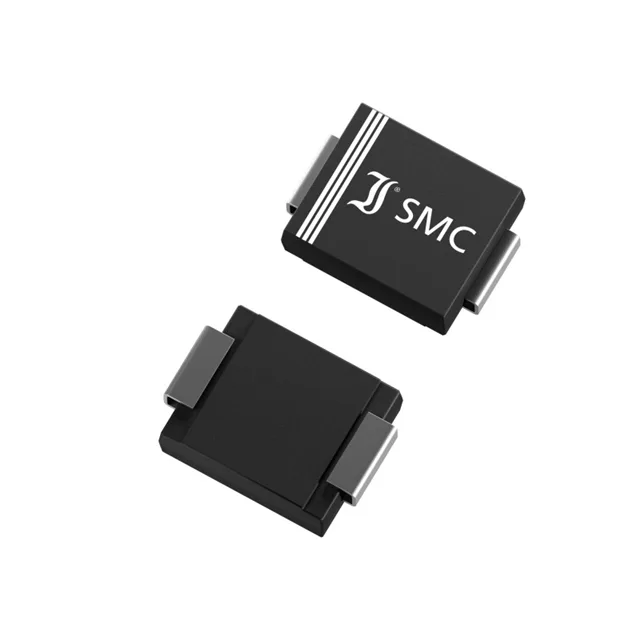
What the 1.5SMCJ70CA is and what it protects
The 1.5SMCJ70CA is a unidirectional Zener-based TVS (Transient Voltage Suppressor) diode in the DO-214AB (SMC) package — a common choice for clamping surges on DC power rails in industrial and consumer electronics.
Standoff, breakdown, and clamping — the three voltages that decide protection fit
The reverse standoff of 70 V is the working voltage — the rail can sit at 70 V continuously without the TVS conducting.
Peak pulse power and surge energy — sizing the device for the threat
At 13.3 A peak current the clamping ceiling of 113 V is the governing figure; the 1.5 kW rating tells you the device survives that single-event surge without shifting its Zener voltage. Repetitive transients below the peak-pulse rating accumulate — if the surge events are frequent, a higher-power TVS in the same case size keeps the junction cooler over life.
DO-214AB SMC — surface mount with field-rework practicality
The DO-214AB (SMC) package is the largest of the three common SMC sizes — wider than the SMA and narrower than the SMB — which gives it better surge-withstand per the higher power rating. The Tj rating of -50°C to 150°C means it handles the full industrial temperature band; a standard hot-air rework profile works fine since there is no exposed heatsink pad to manage. The cathodes are marked on both sides of the wide body, so orientation is unambiguous even under magnification.
Where Zener TVS diodes like this one sit in a circuit
Placed across the power rail and ground, a Zener TVS clamps overvoltage transients before they reach downstream ICs. The 70 V standoff rating suits 48 V and 54 V nominal DC rails — telecom equipment, industrial control, and automotive 12 V/24 V systems after the input filter stage. The bidirectional CA variant clamps both polarities, which is the configuration needed when the protected node floats or sees differential surge events. Power line protection is not the primary function — the datasheet flags this as a no for that role — so it protects signal and low-power rail nodes, not the AC mains entry point.