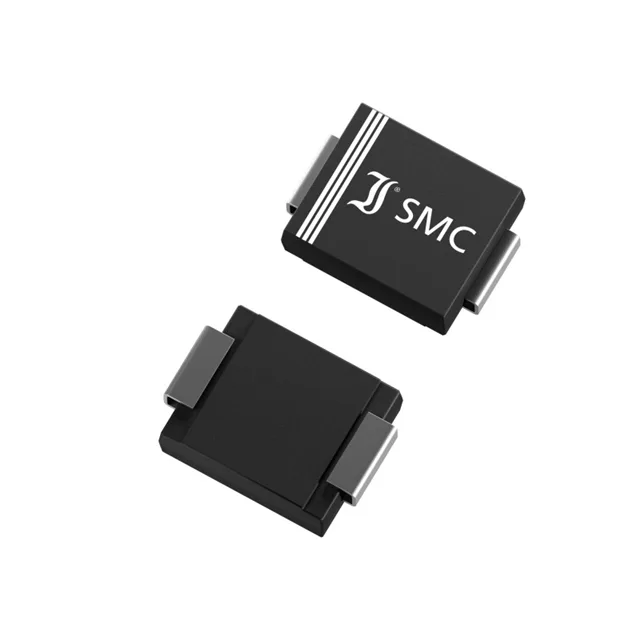
What the 1.5SMCJ7.0A does on a board
The 1.5SMCJ7.0A is a unidirectional transient voltage suppressor — listed as a Zener type, but wired and characterized as a one-way clamp that fires when a voltage spike exceeds its breakdown threshold, routing the surge current safely to ground rather than letting it stress the downstream ICs.
Reverse standoff of 7 V is the maximum continuous working voltage the TVS tolerates without conducting — so the protected rail sits comfortably below that ceiling during normal operation. Breakdown kicks in at 7.8 V minimum; the clamping voltage that actually appears across the TVS during a 10/1000 µs surge event is 12 V maximum at 125 A peak pulse current. That 12 V is what the downstream circuit sees during the event — the let-through voltage the protection is rated to limit.
Junction temperature range and thermal margins
Operating junction temperature runs from -50 °C to 150 °C — the wide cold end covers outdoor and cold-start conditions while the high end gives headroom in confined enclosures without forced cooling.
Package and board footprint
The DO-214AB (SMC) package is the industry-standard outline for 1.5–3 kW TVS diodes. Surface-mount termination demands a copper pad sized per the datasheet thermal recommendation — the cathode tab is the primary heatsinking surface for surge energy dissipation.