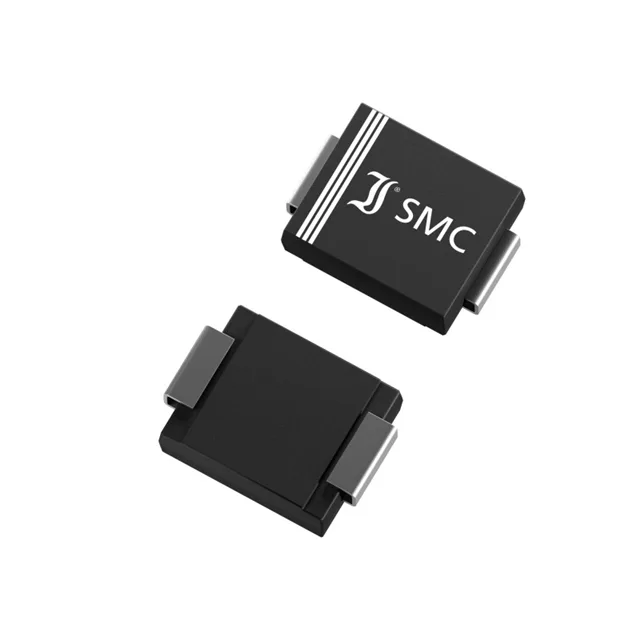
1500W peak pulse — what the clamping spec means
The 1.5SMCJ64C is a unidirectional Zener-based TVS diode rated 1500W peak pulse (10/1000 µs waveform) from Diotec Semiconductor — a transient suppressor, not a power regulator. Its job is to clamp voltage spikes and divert surge current away from protected circuitry, staying passive until the event hits the breakdown threshold. With a typical reverse standoff of 64V, the diode sits invisible across the rail during normal operation. When a transient exceeds the 71.1V minimum breakdown, it snaps into conduction and clamps the peak at 114V — that 1.78× ratio between clamping level and standoff is what defines the let-through voltage the downstream circuit must withstand. If your application carries faster, higher-di/dt transients (such as inductive kick or capacitive discharge events shorter than 10 µs), the clamping voltage at the actual peak current will be higher than the 114V spec — always check the Vc vs Ipp curve in the Diotec datasheet for waveforms that differ from the standard 10/1000 µs test condition.
Junction thermal margin and SMT assembly
The junction operating range spans -50°C to 150°C TJ, which is the standard industrial band for unprotected input rails and secondary-side clamping. At the 150°C ceiling the diode still maintains its rated breakdown and clamping performance, but the peak pulse rating does not derate linearly — the datasheet derating curve governs how much of the 1500W rating survives at elevated TJ. Thermal pad under the package should connect to a generous copper pad on the board for pulse handling; the diode's transient thermal impedance (ZthJC) is the limiting factor during repeated surges, not the steady-state thermal resistance. Strip packaging means individual parts or cut tape rather than a reel — confirm the pick-and-place system can handle the loose-tape or strip format before committing to a production build quantity.