What the clamping specs mean for your circuit
The 1.5SMCJ60: The 60V reverse standoff is the working voltage — the TVS sits idle below this level and draws only leakage current. The clamping ceiling at 107V at 14A peak pulse (10/1000µs waveform) is what your downstream IC actually sees — a 47V overdrive clamped to under 2× the standoff level gives most 48V-tolerant circuits a survivable event. A 1kV surge into a 60V rail at 14A peak delivers roughly 1.4kW for the pulse width, within the 1.5kW rating with margin. The datasheet derating curve at longer pulse widths or higher ambient will tell you whether your specific surge scenario is covered.
Package and thermal margins
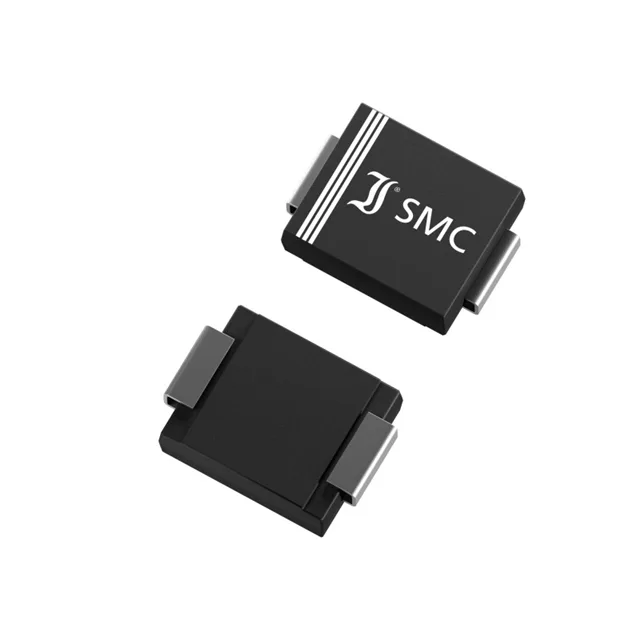
DO-214AB (SMC) is the mid-size SMA-footprint package — the cathodic tab die-attach area sets the RthJC. The 150°C maximum junction temperature with a typical FR4 thermal pad gives you roughly 100°C temperature rise at the rated 14A pulse before the clamp engages. In continuous standoff-bias at elevated ambient, the leakage current rises sharply above 100°C junction, so a snubber/clamp that fires regularly pushes the part toward thermal runaway if the board thermal path is weak. Tape & Reel packaging confirms standard SMT assembly flow — IPC/JEDEC J-STD-020 moisture sensitivity level for this package family is typically MSL 1, but confirm the Diotec datasheet because some SMC variants are MSL 3 and require a bake step before reflow if the shelf life was exceeded.
What 1.5SMCJ60 is not
This is a unidirectional TVS — it protects a positive-going transient on a single-polarity rail. The spec table lists Power Line Protection as No, so it is not a main AC line clamp; it is sized for secondary protection on DC rails, signal lines, and low-power distribution nodes. A bidirectional TVS or a 1.5KE part (higher energy rating) is the right pick for AC line or motor transient suppression. One channel, general purpose, no built-in thermal fusing — the board-level protection scheme must account for that.