What the clamping voltage means for the downstream IC
The 1.5SMCJ58CA-AQ: Working backward from that clamping level to the IC's abs-max input rating is the normal design sequence for any automotive ECU input. The 58 V reverse standoff is the dc working voltage — the diode is reverse-biased and conducts no significant current below it. Above 58 V the device begins to avalanche at 64.4 V minimum, clamping the overvoltage at 93.6 V so long as the transient energy stays within the 1500 W peak pulse rating. The 16 A peak pulse rating at 10/1000 µs defines the waveform class — this is the automotive load-dump pulse shape. A faster-edge event (ESD, 8/20 µs) delivers the same peak current at higher instantaneous power; the clamping voltage will be higher and the device may not survive if the waveform class is mismatched.
Why the automotive temperature grade matters
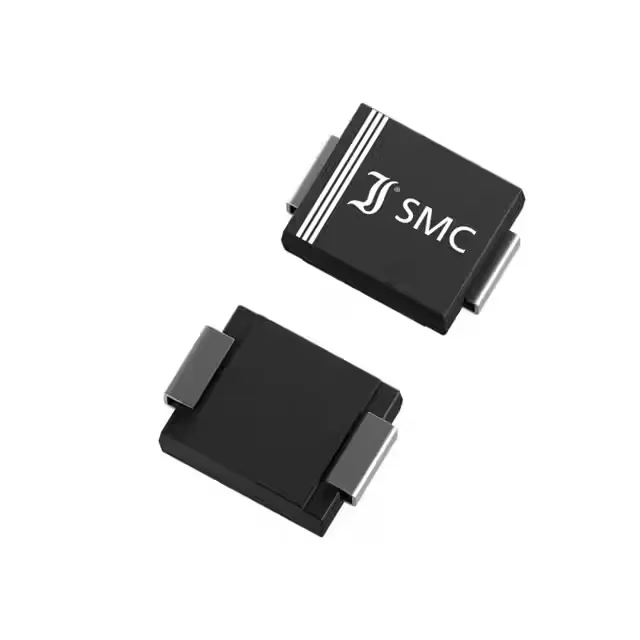
A design that runs the diode at full pulse rating in a 125 °C ambient still has margin to the 150 °C ceiling, but the thermal resistance from junction to ambient on the DO-214AB package determines whether the repetitive-pulse duty stays within that window. The bidirectional CA variant means both polarities share a single SMC package — polarity one clamps positive transients, polarity two clamps negative. This is the correct topology for protecting floating automotive signal lines where neither side is ground-referenced, or for protecting the drain-to-source path of a MOSFET that sees both polarities during switching.