Peak pulse and clamping — what the 1.5 kW rating actually means
The 1.5SMCJ58A is a unidirectional Zener-based TVS diode — it clamps a transient surge to a defined voltage ceiling rather than absorbing it silently, which is exactly what protects downstream circuitry from overvoltage events. The 1500W peak pulse rating at the standard 10/1000 µs waveform sets this well above the common 500W parts in the same SMC package, meaning it handles higher-energy transients without derating to a lower class of protection. The standoff voltage of 58 V typ defines the working DC bias the line can sit at continuously without the TVS conducting. If a surge drives the line above that, the device breaks down at 64.4V minimum and clamps the peak pulse current of 16 A to a maximum of 93.6 V — that clamping ceiling is what the protected circuit actually sees at the defined current.
Junction thermal margin and deployment environment
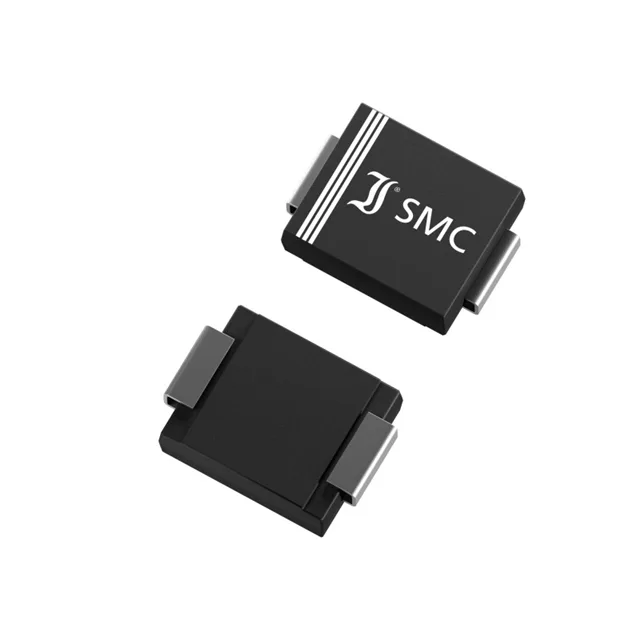
Junction temperature is rated from -50°C to 150°C — the upper end gives meaningful margin against the self-heating pulse during clamping events, so the part is viable in enclosed industrial enclosures without active thermal management. General-purpose application rating means it is not screened to automotive AEC-Q101 or defence JAN specs, but for industrial and commercial boards the temperature band is sufficient. The DO-214AB (SMC) package is the standard surface-mount footprint for this power class — the cathodic tab on the wide side maps to the protection rail, and the matching land pattern seats to the board without special keep-out. No power-line protection flag in the listing means this is a board-level protection device, not a mains-supply TVS per IEC 62368 or similar.