What the 5 V standoff and unidirectional architecture mean
This puts it squarely in the secondary-side and DC-rail protection role, not the AC line-side position. The entry confirms it carries no power-line protection rating, which is the expected boundary for a DC-rail clamp sized well below mains voltages. The 'C' suffix in the 1.5SMCJ5.0C naming convention denotes the bidirectional variant of the series. The unidirectional counterpart — with an 'A' suffix — shares the same standoff and breakdown ratings but can only protect one polarity. For a bidirectional fault path or an AC waveform, the 'C' variant is the drop-in; for a strict DC positive rail the 'A' variant is the usual pick.
Surge ceiling and clamping performance
The minimum breakdown voltage is 6.4 V — conduction onset for the Zener channel. Below 6.4 V the device is off and leaks only the standing reverse leakage current; above it the avalanche characteristic drives the clamp. The window between 5 V standoff and 6.4 V minimum breakdown is the design margin — the part must not conduct under the maximum expected DC working voltage.
Thermal and package fit
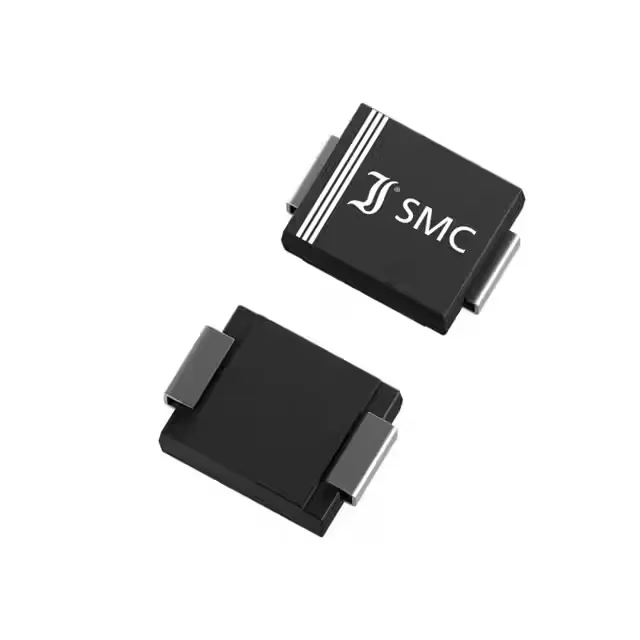
The junction temperature range of -50°C to 150°C with a thermal resistance governed by the DO-214AB (SMC) package fits standard surface-mount reflow assembly. The copper pad under the SMC body carries heat away — a adequate land pattern on a multi-layer board keeps the junction within the 150°C ceiling during the peak pulse. For repetitive surge events, the thermal cycle between events matters as much as the single-pulse rating.
Diotec Semiconductor lists the 1.5SMCJ5.0C as Active. The DO-214AB SMC footprint aligns with the dominant industry package for this power class, which gives reasonable second-source options if the BOM requires a hedge, though the exact standoff and clamping values should be verified against any alternative datasheet.