What the 45V standoff rating means for your rail
The 1.5SMCJ45A: The 45V reverse standoff (typ) is the maximum voltage the TVS sees in normal circuit operation — the downstream IC or rail being protected must sit below this at all times, including at the top of its tolerance band. When a surge exceeds the 50V minimum breakdown threshold, the device transitions to conduction and clamps the voltage at 72.7V maximum regardless of how high the incident surge current climbs — up to the 20.6A peak pulse rating.
A faster 8/20 µs surge (first-stroke lightning) delivers the same energy in less time, so the clamping level at a given current can be lower — but the part's survival hinges on not exceeding the 20.6 A Ipp ceiling at the stated 10/1000 µs shape. The unidirectional topology means it clamps only one polarity — for AC rails or bidirectional protection you need a separate TVS or a bidirectional device. The power-line-protection flag confirms this is a board-level transient suppressor, not a mains-side protector.
DO-214AB SMC footprint and thermal margins
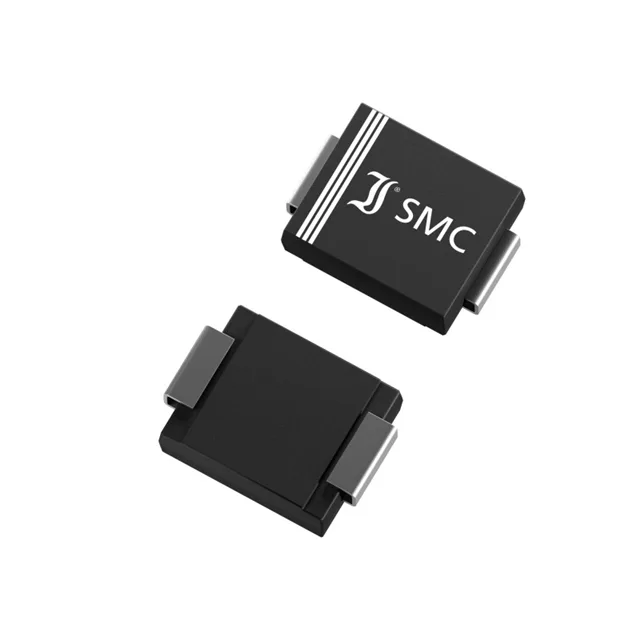
The SMC (DO-214AB) package is the mid-size surface-mount TVS footprint — larger than the SMA (DO-214AC) and smaller than the SMB — which places it between the SMB's higher peak-pulse rating and the SMA's lower cost. Pad layout follows the standard SMC land pattern; the cathode bar marks polarity on the reel. Junction temperature is rated -50°C to 150°C. At the upper end, clamping voltage increases and peak-pulse capability decreases per the temperature-derating curve — for a TVS protecting a 24V rail in a confined enclosure, confirm the worst-case ambient plus self-heating keeps the TJ below 150°C under the longest expected surge.
Sourcing — active production from Diotec
Available to order through independent distribution; pricing and lead time confirmed at RFQ.