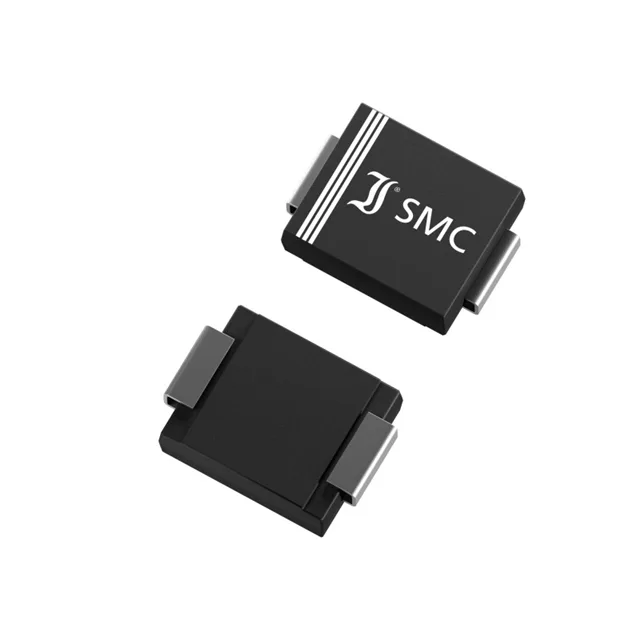
Clamping performance at a surge event
The 1.5SMCJ43CA clamps transients at 69.4 V maximum at a peak pulse current of 21.6 A — that 69.4 V is the let-through voltage the downstream circuit sees when a 10/1000 µs surge hits the line. Below 43 V standoff the device sits in its high-impedance Zener region and draws only leakage current, so normal 43 V rail operation is undisturbed.
Peak pulse power of 1500 W is defined on the 10/1000 µs waveform — a 10 µs rise time and 1000 µs fall time, which covers the fast-rise inductive switching spikes found in relay coils and motor drive kickback paths. The 21.6 A peak pulse current rating at that waveform tells you the current the diode conducts while clamping at 69.4 V, so the clamping voltage under a real surge scales with the actual available fault current.
Industrial temperature grade for motor drive and power supply environments
The thermal impedance of the DO-214AB package sets the system-level transient thermal response; a brief surge event stays within the transient thermal impedance curve.
Bidirectional polarity handling
One bidirectional channel means both positive transients (line-side surges) and negative transients (ground reference swings, motor reversal inductive kick) are clamped by the same device — no need to orient a unidirectional diode for polarity, and it works regardless of which rail the protected node sits on.