TVS diode — what the voltage chain means for protection design
The reverse standoff voltage of 43 V defines the continuous working voltage the diode sees in normal operation — the circuit should run below this so the TVS sits dormant until a surge arrives; the minimum breakdown of 47.8 V gives a small hysteresis window above the standoff before conduction begins. This is a unidirectional TVS, so it protects one polarity — positive transients on the line relative to ground. For bidirectional protection a dual-polarity TVS would be required; the 1.5SMCJ43A is not the right fit for AC lines or signals that swing both ways.
Peak pulse rating and what 1.5 kW means in the field
The junction temperature range of -50°C to 150°C covers cold outdoor equipment startup and enclosed-panel warmth without derating within those bounds — above 150°C TJ the manufacturer specifies end-of-life, so thermal design should keep the diode's effective TJ below the datasheet limit in the worst-case fault scenario.
Package and assembly — DO-214AB in strip form
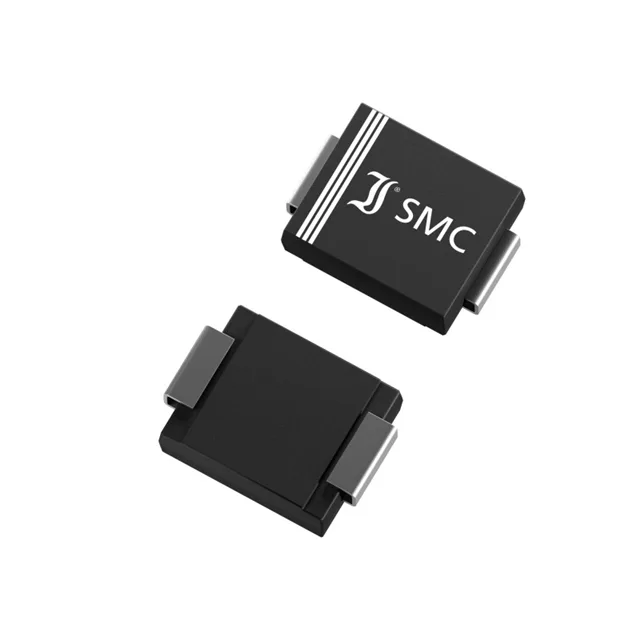
The SMC (DO-214AB) is a standard JEDEC surface-mount package — the footprint matches the industry-standard TVS diode landing pattern, so it drops onto most reference designs without layout changes. The strip packaging means it ships in linear cut-tape; confirm whether the assembly line expects reel-and-tape or whether strip works for the pick-and-place setup. Power line protection is marked No in the listing — this part protects individual signal and low-power rails, not the AC mains bus itself. For board-level protection on a 24 V or 48 V rail, the 43 V standoff sits comfortably above the nominal rail; for 48 V telecom the standoff is borderline and a higher-standoff TVS may be cleaner.