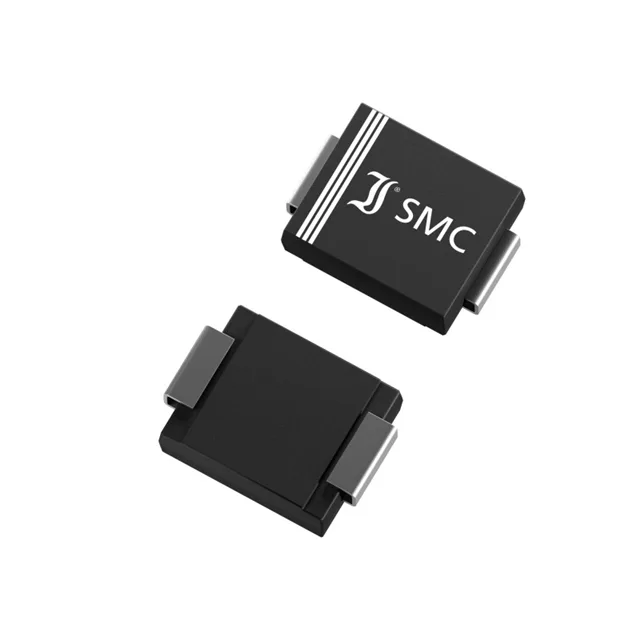
What the 1.5SMCJ33 does on a board
The 1.5SMCJ33 is a unidirectional Zener-based TVS diode — it sits reverse-biased across a power or signal rail and clamps transient overvoltage spikes to a safe ceiling before they reach downstream circuitry. A designer picks this rating against the worst-case transient amplitude and source impedance on the target rail; if the available peak current exceeds 25.4 A, a parallel TVS or a higher-power part is needed.
Junction temperature and thermal margin
The junction operating range runs to 150 °C, which gives good headroom for automotive and industrial environments where the ambient at the PCB can hit 85 °C and the TVS self-heating during a clamping event adds delta-T on top. The -50 °C low end covers outdoor and cold-start conditions. At 150 °C junction maximum and a 25.4 A clamping event, the instantaneous dissipation during the pulse is significant — board-level thermal design (copper pad under the SMC body) determines whether the transient thermal impedance stays within the rated pulse window.
SMC/DO-214AB is the standard 2-pin surface-mount outline for 1500 W TVS parts — it mounts to a landing pattern shared across the full 1.5SMCxx series variants, so a layout accepting one standoff voltage accepts any other voltage in the series without a board spin. Strip packaging is the standard reel-free option for lower-volume pick-and-place. The unidirectional single-channel topology means it protects one polarity only — line-to-ground on a positive rail. For AC or bidirectional protection a dual-polarity or back-to-back part would be required; this part is not a power-line protection device.