What the clamping ratings mean for your protection circuit
The 1.5SMCJ30CA is a unidirectional TVS diode specified at 30V reverse standoff — the circuit runs at normal operating voltage with this as the upper limit. That 48.4V clamping ceiling is what the downstream IC or rail actually sees, so the downstream component's absolute-max rating must sit above it with margin. Sustained or repetitive transients above that waveform shape will push the junction temperature higher than the 150°C TJ ceiling, so the clamping voltage and peak current must be evaluated against the actual surge environment the end equipment will see.
Junction temperature and thermal environment
The DO-214AB (SMC) package thermal resistance from junction to ambient determines whether the 150°C ceiling holds under the actual mounting and airflow conditions on the board. This temperature range places the part in general-purpose industrial territory — not qualified for automotive AEC-Q101 or defense JAN screening, so for those programs a screened alternative would need to be identified separately.
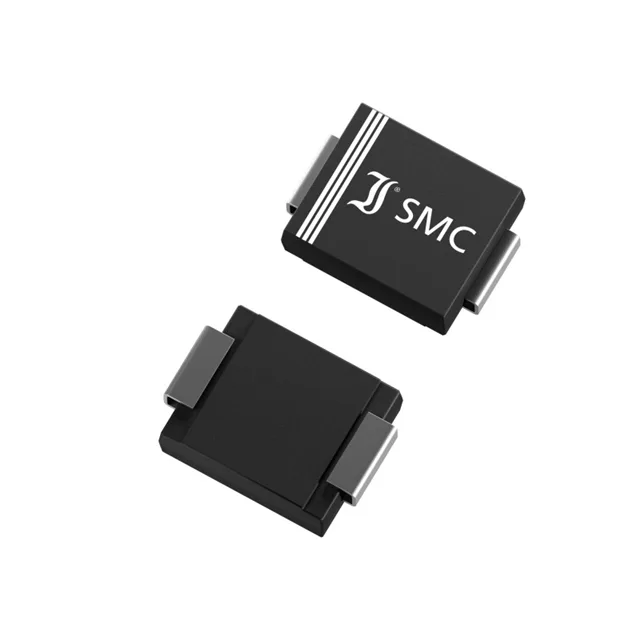
Surface-mount DO-214AB (SMC) package — the standard footprint for 1500W unidirectional TVS in this voltage class. Pin 1 is the cathode (identified by the band on the body), pin 2 the anode. The package ships as cut strip for feeder placement; the SMC body is wider than the smaller DO-214AA (SL) variant, so verify the pad layout matches this footprint before committing a new board spin. The part is listed for general-purpose applications and is not characterized as a power-line protection device — the 30V standoff rating and single bidirectional channel confirm it is not intended for direct AC line clamping at 220/240V.