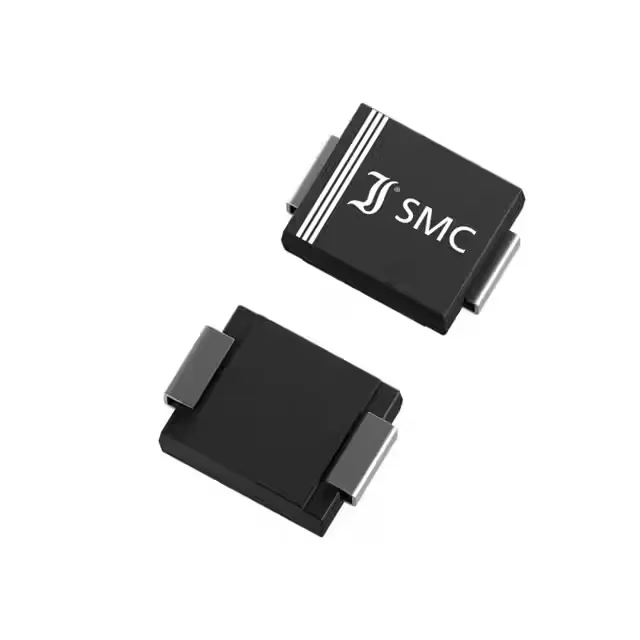
Clamping action and the standoff-to-breakdown window
The 1.5SMCJ26CA-AQ blocks at a typical standoff of 26V — below the minimum breakdown threshold of 28.9V — and remains idle in normal operation.
At that pulse width the diode can absorb the stated 35.6A peak current without degradation; a longer or faster pulse shape would stress the device differently and the effective clamping voltage would shift. Matching the diode's rated waveform to the threat profile of the end application is the selection step — the 1.5 kW figure alone does not tell you whether it survives a given real-world event. The 26V standoff sits above the 24V nominal automotive rail with headroom, but below the breakdown — this is the standard design gate for a 24V-system TVS. A 12V automotive rail would typically use a standoff in the 13–18V range; the 26V standoff on this part correctly targets 24V supply rails and related node protection.
Junction temperature and automotive fit
The junction temperature rating of -50°C to 150°C is the automotive grade band — it covers both cold-start under-hood conditions and the upper envelope of a thermally loaded engine bay. This is not a commercial-grade part with a relaxed temp range; the Tj rating aligns with the end-use environment the applications field implies.
DO-214AB package and board integration
The strip packaging format is typical for full-reel replacement or manual assembly; confirm the reel quantity before committing a high-volume BOM line. The power-line protection field is listed as No — this part is a general Zener TVS for node-level clamping, not a power-line protection module. Designers seeking protection at the supply entry point should verify the clamping energy and standoff voltage match the input-stage threat model, not assume this device covers the main power rail without additional qualification.