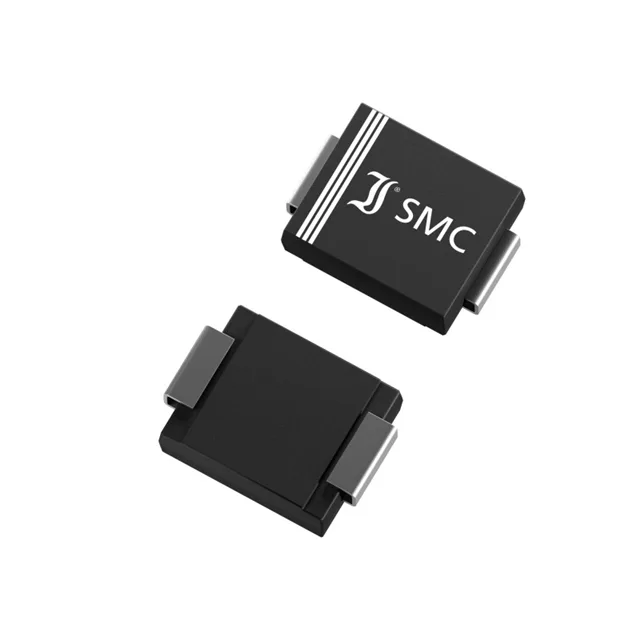
The 1.5SMCJ26C: For a 24 V nominal line, that ~2.9× headroom between standoff and minimum breakdown gives legitimate transient margin without premature turn-on under supply noise or line dip.
What the junction temperature ceiling means in practice
Rated to 150 °C junction (TJ max) with an operating range that bottoms out at -50 °C — this covers the full industrial envelope. The -50 °C low end matters for outdoor or cold-start environments; a TVS that conducts at cold temperatures can clamp a supply rail below its normal operating point and cause a brown-out if the clamping current pulls the rail down. The 150 °C ceiling is the usual IPC ceiling for a lead-free solder joint on a FR-4 board running near thermal limits. Unidirectional, single bidirectional channel — it protects one polarity of fault. If the board runs a split-rail or bipolar supply, you need a complementary TVS for the negative rail or a bidirectional part; this one does not float across a bipolar node.