Standoff, breakdown, and clamping — the three voltage ratings
The 1.5SMCJ22C: The 22V reverse standoff is the working voltage below which the device stays passive — the line sees only the diode's low reverse leakage until a transient pushes it into conduction. At 24.4V minimum breakdown, the Zener avalanche kicks in, snapping the line to the clamping ceiling. The 39.4V maximum clamping voltage at the rated 38.1A peak pulse current is what the downstream load actually survives — that number, not the standoff, is what the protection circuit designer holds against the TVS datasheet limit.
1500W peak pulse rating is specified on the 10/1000µs IEC 61000-4-5 waveform — the classic 1.2/50 µs voltage surge and 8/20 µs current impulse combination that telecom and industrial enclosures face at the port entry point. Running a slower or longer-duration surge against the same peak wattage pushes the thermal budget differently; the clamping characteristic curve in the Diotec datasheet maps the derating.
Bidirectional, single-channel — polarity math
The 1.5SMCJ22C is a single-channel bidirectional TVS, meaning it clamps both polarities without a separate polarity stack — a ground-referenced line that can see both positive and negative transients (triggered by switching or ESD coupling) needs exactly this. The C-suffix confirms bidirectional; an A-suffix in the same series would be unidirectional.
DO-214AB package and junction thermal margin
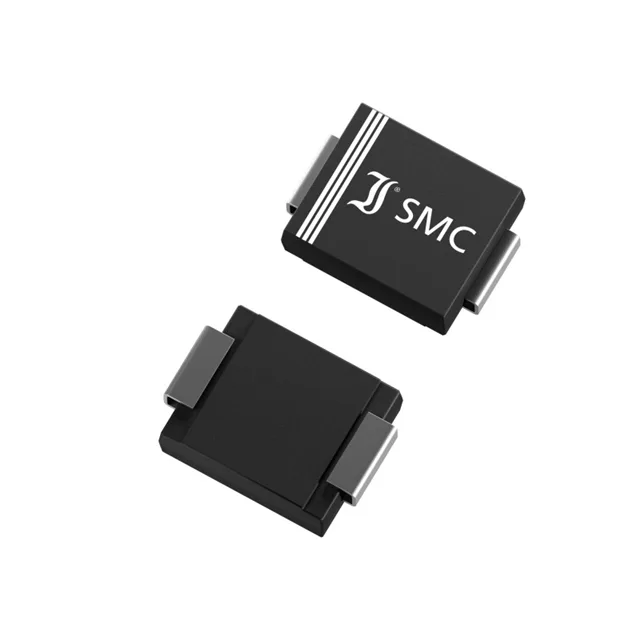
The SMC/DO-214AB body mounts flat to the PCB with a soldered cathode tab — the exposed pad under the package tab is the primary thermal path. With a TJ max of 150°C, the layout's copper area and any adjacent airflow determine how much of the 1500W peak pulse the board can actually sink without the junction exceeding its limit on a long-tail surge.
Listed as Active by Diotec Semiconductor. Available to quote against a BOM line — lead time and lot-specific pricing confirmed at RFQ through independent distribution. Diotec maintains its own 1.5SMCJ series lineup as the primary product family.