What the clamping ratings mean for your board
The 1.5SMCJ22: The 22V reverse standoff is the working rail the TVS must not clip during normal operation — it sits above the nominal supply voltage so the diode stays off the characteristic curve until a transient arrives. When the surge exceeds 24.4V (the minimum breakdown), the device turns on and clamps the peak at 39.4V, limiting what reaches the downstream circuitry. At that clamping voltage the part sinks 38.1A peak pulse (10/1000 µs waveform), which is the survivable surge current rating for this class of board-level TVS. One unidirectional channel means this part protects a single polarity — positive transients on a positive rail. For AC or bidirectional protection you need a dual-polarity or back-to-back TVS; this is not a symmetric clip.
DO-214AB SMC — board footprint and thermal context
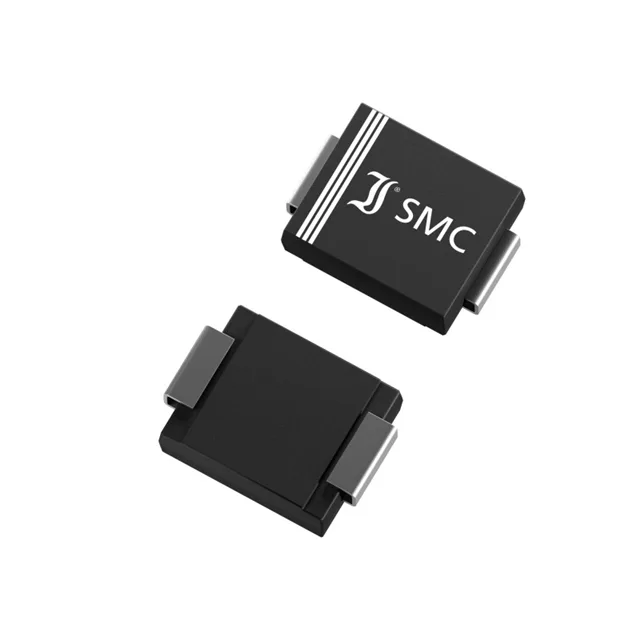
Surface-mount SMC (DO-214AB) is the standard 2-pin J-bend package for TVS diodes on power and signal boards. The cathode bar on the package marks polarity — confirm the orientation before reflow, because a reversed TVS conducts forward-biased at roughly 0.7V and provides zero transient protection. Operating junction temperature runs to 150°C, which gives margin on boards that see elevated ambient or thermal cycling — the 150°C ceiling is set by the die attach and epoxy system, not the silicon alone.