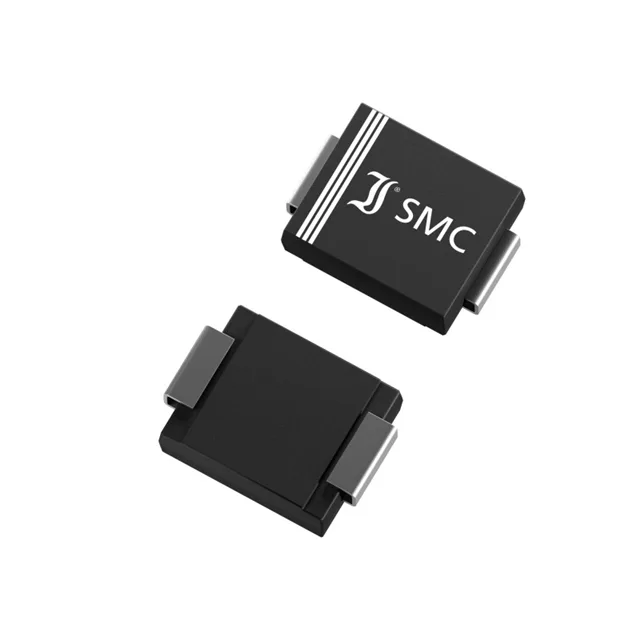
What the 1.5SMCJ20C protects — and how the ratings decide the fit
The reverse standoff voltage sits at 20 V typ, meaning the device stays off and draws only leakage current during normal bus operation up to that rail. When a voltage transient drives the line above the 22.2 V minimum breakdown, the diode clamps the spike to 35.8 V maximum at 41.9 A peak pulse current, protecting downstream ICs and MOSFET gates from overvoltage damage. The 20 V standoff gives roughly 3 V of headroom above the nominal rail before conduction begins, which is the normal design trade-off — enough margin to avoid leakage-drain during ringing, tight enough to catch fast transients before the protected device sees damage.
Surge immunity and thermal margin
The surface-mount DO-214AB footprint is reflow-solderable, and the SMC body is one of the more common TVS packages, so swapping it on a rework bench with hot air is straightforward when a board comes in for failure analysis. The single bidirectional channel count is listed as 1 — this device is unidirectional, clamping only positive transients in one direction. For AC line or dual-polarity protection, a bidirectional TVS or a back-to-back pair would be required.
Where TVS diodes of this class land in a panel
TVS diodes in this power class are typically placed on the DC bus feeding downstream loads — motor drive output stages, relay coil kickback rails, sensor supply lines. The general-purpose applications rating means there are no enforced restrictions on the protected circuit type, so it sees use across power supplies, lighting controls, and communications interface protection as a first-stage clamp before the bulk TVS or varistor higher up the chain.