What 18V standoff and 32.2V clamping mean for the protected rail
The 1.5SMCJ18C holds off at 18 V without conducting — the protected rail sees no TVS loading in normal operation. That 14.2 V differential between standoff and clamp is the protection headroom the downstream circuitry lives on. The clamping voltage at 32.2 V times the peak current of 46.6 A gives roughly 1.5 kW, so the datasheet ratings are consistent with the power class. On a 24 V nominal DC rail, the 18 V standoff gives adequate margin above the operating voltage while keeping the breakdown below the 32.2 V clamping ceiling most downstream ICs tolerate.
SMC/DO-214AB surface-mount footprint — reflow assembly fit
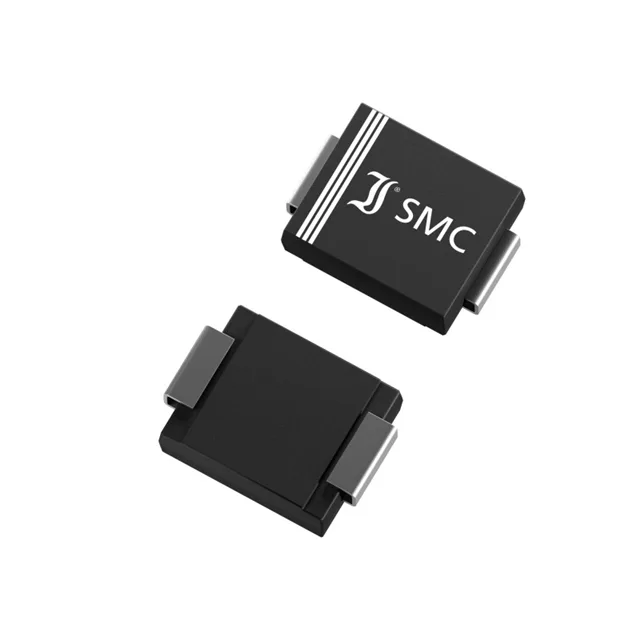
The DO-214AB (SMC) package is the mid-size TVS footprint — larger than the SMA (DO-214AC) and smaller than the SMB (DO-214AA). It lands on a standard IPC-7351 pattern; the cathode band marks polarity on the sleeve. For a unidirectional TVS the band faces the protected line; pin 1 is the cathode. The strip packaging means it ships on tape or rail intended for production pick-and-place — confirm your feeder can handle the DO-214AB form factor before committing a new production build.
Unidirectional vs bidirectional — which surge direction this clamps
For AC rails or signal lines that swing both polarities, a bidirectional TVS or two antiparallel unidirectional diodes are required. The single bidirectional channel entry describes the device topology, not the protection mode: this part is polarity-sensitive on the input side. Verify the surge threat in the application is unidirectional before selecting it — a reverse-polarity surge on an unprotected negative half-cycle can destroy the diode.