What the 18V standoff and 29.2V clamping rating mean for your circuit
The 1.5SMCJ18A-AQ clamps the line at 29.2V maximum when a 51.4A surge (10/1000 µs waveform) strikes — any downstream semiconductor seeing a rail spike must survive 29.2V at its pins before the TVS commits. The 18V reverse standoff is the working voltage the diode blocks in normal operation; the 20V breakdown minimum marks where it starts conducting during a transient event. For a 12V automotive rail, 18V standoff gives comfortable headroom above the nominal battery voltage, and the clamping ceiling stays below what a typical MOSFET gate or ECU input can tolerate.
Automotive temperature grade and what the 1500W rating means
Using it as a continuous clamp across a power rail would exceed its thermal limits.
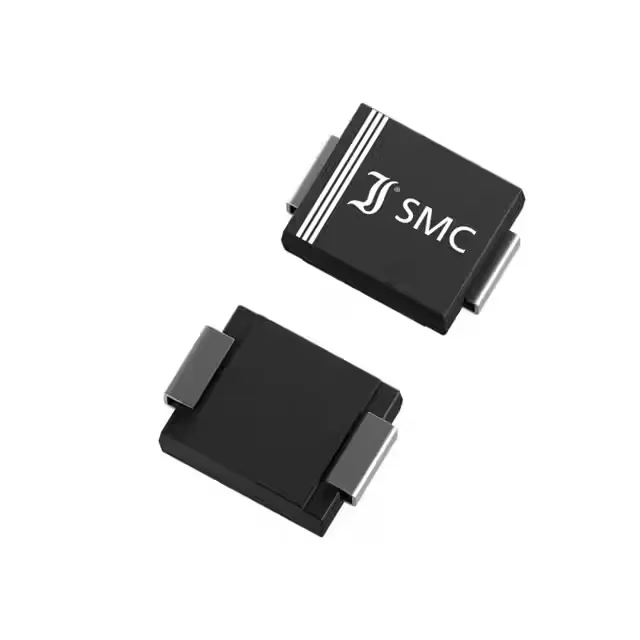
DO-214AB SMC package — what the footprint means for the layout
Surface-mount SMC (DO-214AB) package — the cathode bar is the thermally active side and must connect to a copper pad sized for the transient thermal impedance. On a two-layer board the pad under the cathode tab carries the heat away; on a four-layer board the thermal vias under the pad drop junction-to-ambient resistance significantly. The unidirectional single-channel topology means the cathode faces the protected line and the anode ties to ground — orientation matters, and the SMC package has no polarity-ambiguity markings beyond the bar.