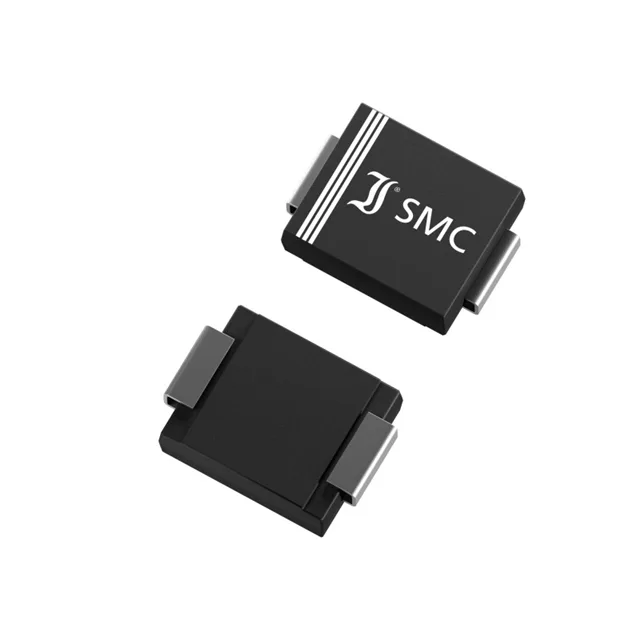
170V standoff — what the clamping spec means for board protection
The 1.5SMCJ170A: The 170V reverse standoff is the maximum rail the diode sees undisturbed — above it the Zener channel turns on and clamps the transient. At 275V the device limits the peak surge to 5.5A for the 10/1000 µs waveform, which is the standard 1.2/50 µs generator setting scaled for the 1.5 kW rating — above 170V the downstream semiconductor sees a hard ceiling rather than the raw source voltage.
Industrial temperature grade and SMC footprint
The DO-214AB (SMC) package mounts directly to the PCB pad; the cathodic tab carries the heat away under surge conditions, so the board pad layout and solder joint quality directly affect the part's real-world clamping performance under repeated transients. Surface-mount form factor means it reflow-solders into the board alongside active components — no through-hole stress on the pads during thermal cycling, but the moisture sensitivity level (MSL) on the tape-and-reel shipment should be confirmed against the assembly house bake schedule before reflow.
Listed as Active by Diotec Semiconductor — no official NRND notice or end-of-life record on file. No L* successor or cross-reference sibling appears in the ledger, so confirm the standoff and clamping ratings against the actual board-level transient threat before committing the BOM line.