The 1.5SMCJ16C clamps transients on a signal or low-power rail — the 16V reverse standoff sits above the working voltage so the diode stays off during normal operation, and the 17.8V minimum breakdown is where it begins conducting when a surge arrives. At the peak pulse condition of 52.1A (10/1000µs waveform), the clamping voltage ceiling is 28.8V — the downstream circuit sees that as the maximum stress, not the raw surge amplitude. That 28.8V figure is what you use to verify the protected IC's maximum ratings. The 1.5kW peak pulse rating defines the transient energy the part can absorb once without degradation. This is a unidirectional single-channel device (the field listing a bidirectional channel is a data-classification artifact — the 1.5SMCJ family is uni-directional; the C suffix denotes the bidirectional variant in the broader SMCJ series, but the 1.5SMCJ is itself unidirectional by design).
DO-214AB SMC package and board integration
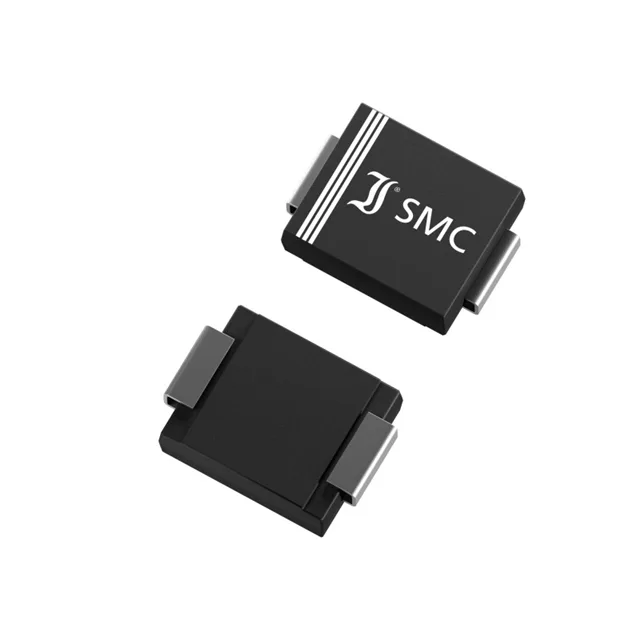
The DO-214AB (SMC) is a standard two-lead claw-foot package — the cathode bar is the longer pad in the footprint. Solder joint reliability on the leads governs the thermal path more than the package itself; a proper thermal pad under the die attach improves the repeatable pulse capability. Surface-mount reflow profile — the part ships on strip, consistent with standard SMD handling. Not a power-line protection device — the 1.5kW rating is for board-level signal and secondary supply protection, not AC line-front protection. A power-line TVS would carry a different waveform rating and package thermal margin.