160V standoff bidirectional TVS — what the voltage window means
The 1.5SMCJ160CA is a bidirectional Zener-based TVS diode — the standoff voltage of 160 V sets the continuous working voltage the line can sit at without conduction, while the 178 V minimum breakdown is where the device begins clamping an incoming surge. At the clamping specification of 259 V maximum at 5.8 A peak pulse, the device limits the overvoltage spike to a level the downstream circuit survives. The 10/1000 µs waveform rating of 5.8 A peak pulse at 1.5 kW defines the energy the part absorbs during a lightning-surge or switching-transient event — this is the standard IEC 61000-4-5 test wave shape, so the part is directly suited for AC line protection at 130-160 V nominal rails in telecom, industrial control, and power-supply front ends.
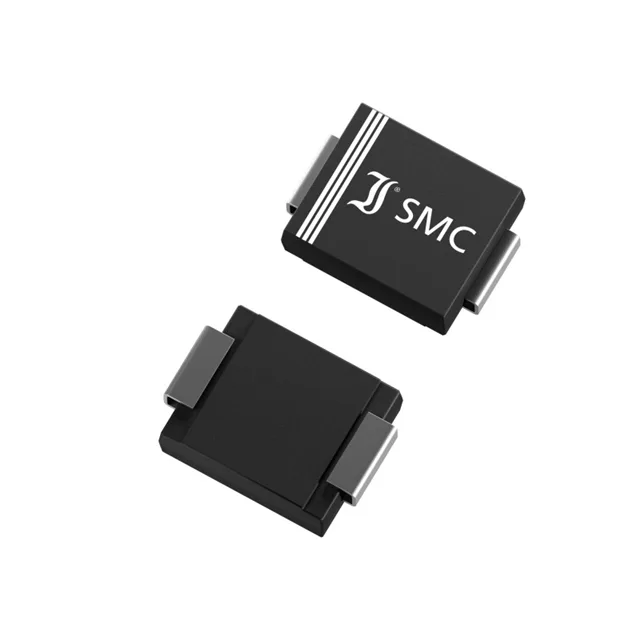
DO-214AB SMC package — thermal and assembly fit
Surface-mount termination means the part is placed by pick-and-place and reflow-soldered — the strip packaging designation confirms tape-and-reel orientation for automated assembly. Verify pad layout against the SMC footprint; the lead-free plating finish is standard for reflow profiles.
Wide junction temperature range and protection topology
The device is listed as not qualified for power-line protection — this means it is a secondary-side protection element, not a primary mains-rated TVS. For direct AC line entry, a dielectric-withstand and creepage-rated part is required; this part sits behind the bridge rectifier or on the DC rail.