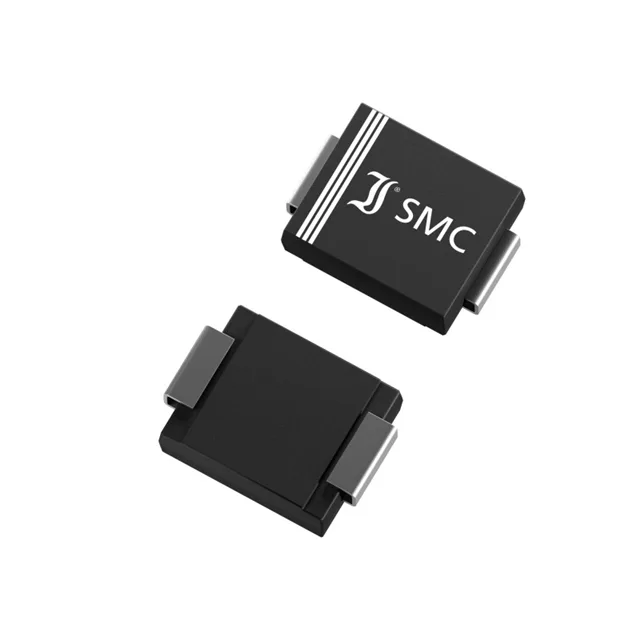
The 1.5SMCJ14A: At 14 V reverse standoff (typ), the device sits dormant across the supply rail. The clamping voltage of 23.2 V at peak pulse current sets the let-through voltage the protected load must survive — for a 5 V or 12 V rail the 23.2 V ceiling gives comfortable margin; for a 24 V nominal line the 14 V standoff already places this part below the working voltage, so a higher-standoff variant would be the correct choice.
SMC package and thermal headroom for board-level designs
Surface-mount DO-214AB (SMC) is the standard industry footprint for 1500 W TVS diodes — it provides a thermally capable anode-tab land area that the layout engineer must pad correctly to achieve the rated junction-to-ambient thermal performance. The 150 °C maximum junction temperature (TJ) is relatively wide for a TVS diode, giving the designer headroom when the clamping event heats the die. For a board running in a enclosed panel at 85 °C ambient, the junction rise during a brief surge is recoverable — but repeated high-energy transients require checking the diode's average power rating against the thermal impedance of the PCB footprint. The listed package style is Strip — meaning cut-tape or loose parts per bag — not embossed tape on reel. Reel-packaged alternatives in the same series are available; confirm the packaging type before committing to the assembly process, as reel parts suit automated placement whereas strip parts require manual or semi-auto pick-and-place setup.
What this part is not — power line protection scope
The datasheet explicitly flags Power Line Protection as No — this part is not rated for direct 120/230 V mains attachment. It is suited for secondary protection on DC power rails, signal lines, and low-voltage distribution nodes downstream of an upstream bulk clamp or main TVS stage. The single unidirectional channel means it protects one polarity — positive transients on a supply rail. For AC-coupled signal lines or bidirectional clamp needs, a dual-polarity or bipolar TVS would be required; the 1.5SMCJ14A clamps only the forward-bias direction.