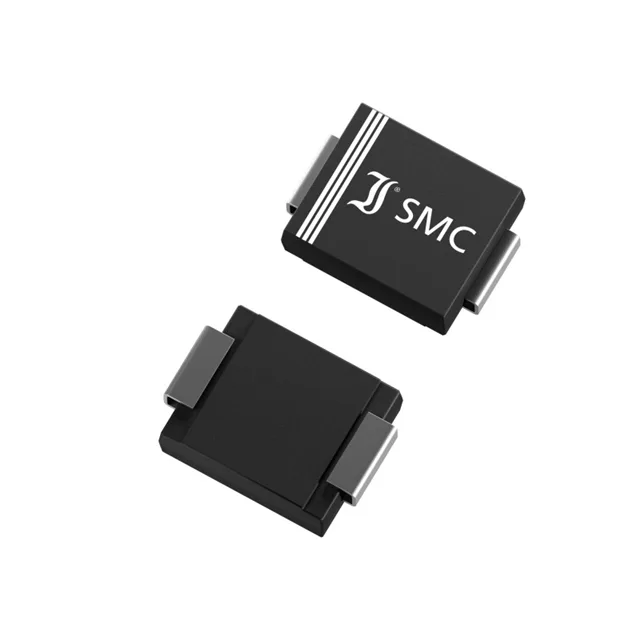
What the 1.5SMCJ13A does on your board
The 1.5SMCJ13A is a unidirectional TVS diode — it clamps transient overvoltage spikes away from whatever circuit sits behind it. When the line is clean the diode stays off; when a surge hits it turns on in under a nanosecond and clamps the voltage at its datasheet limit, then recovers. The series designation 1.5SMC puts it in the 1.5 kW peak-pulse power class in the DO-214AB (SMC) surface-mount package.
Standoff, breakdown, clamping — which rating drives the selection
The reverse standoff voltage is 13 V — this is the maximum working voltage the diode tolerates without conduction. The minimum breakdown is 14.4 V, so the diode stays high-impedance up to that threshold. For a 12 V rail that sees transients, this means the downstream load never sees more than 21.5 V during a surge event, well within the rating of most downstream ICs. The 69.8 A peak pulse current and the 21.5 V clamping ceiling together set the let-through voltage the protected circuit must survive.
Junction temperature and the -50 °C to 150 °C window
The maximum junction temperature is 150 °C with an operating range down to -50 °C. This is a wider-than-commercial window — suitable for industrial enclosures, outdoor equipment, and power-supply environments where cold startup and thermal cycling are both in-scope. The junction temperature rating constrains how much average power the part dissipates under repeated transients; the datasheet derating curve governs the real-world pulse-frequency limit.
Package and SMT assembly
The DO-214AB (SMC) is a standard 2-pin J-bend surface-mount package — the footprint is compatible across all major TVS diode manufacturers at this rating level. The strip packaging is the reel-tape orientation for automated placement. Tin-lead or pure tin finish is manufacturer-dependent; confirm the finish against the Diotec datasheet before reflow profiling, especially if the assembly is going through a lead-free or mixed process.