TVS clamping stack — what the voltage trio means for your rail
The 1.5SMCJ11C clamps a protected rail at the standoff voltage — the maximum reverse working voltage the TVS sees in normal operation without conduction — before the breakdown threshold is reached. At 11 V typical standoff, the rail can sit below 12.2 V without the device conducting; once a transient exceeds the 12.2 V minimum breakdown, the device enters avalanche and clamps the peak at 20.1 V maximum across the full 74.6 A peak pulse current window.
1500W peak pulse rating — sizing for the surge event
Peak pulse current of 74.6 A is the current the clamping action forces through the TVS during a fault event. At 20.1 V clamping, 74.6 A delivers approximately 1.5 kW into the transient — the series impedance of the source, not the TVS, limits the actual peak. Budget the clamping voltage across your downstream load isolation as part of the total let-through energy calculation.
Junction temperature range of -50°C to 150°C places this in the industrial and outdoor deployment class — the lower bound handles cold-store and outdoor-equipment starts; the upper bound covers junction operation in enclosed panels without forced cooling. At elevated ambient, derate the peak pulse power per the datasheet thermal curve; the 150°C absolute maximum is the trip-out ceiling, not a continuous operating point.
Surface-mount DO-214AB — assembly and footprint context
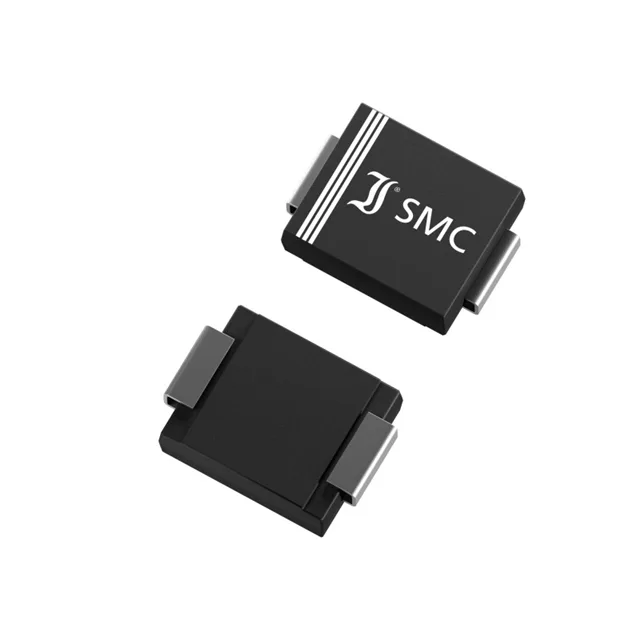
SMC/DO-214AB package with surface-mount termination accepts standard hot-air or IR rework profiles for this package class. The cathode band marks the anode-cathode polarity — this is a unidirectional device, so reverse-bias the cathode relative to the protected node. Strip packaging is typical for reel-free prototyping quantities or manual-reel assembly. Supplier device package is SMC/DO-214AB — electrically and mechanically identical to the JEDEC DO-214AB standard footprint, which means any compliant DO-214AB TVS in the same polarity and ratings class is a potential footprint match, though standoff and clamping values must be verified before substitution.