What the protection window means for your circuit
The 1.5SMCJ100C: The standoff voltage of 100 V defines the normal operating rail this diode watches — it sits off-state and draws only leakage current until a transient pushes it into conduction. For a 100 V rail, that window — roughly 111 V breakdown, 179 V clamping — is the design margin you build your protection budget around.
1500 W at the 10/1000 µs standard is the TVS absorption rating for inductive kick and lightning-surge environments. The 8.4 A peak pulse current at that clamping voltage is the current the diode must conduct while clamping — your upstream source or supply must be capable of delivering that fault current into the TVS without exceeding the standoff voltage. In practice, the diode absorbs the energy and the downstream load sees the clamped 179 V ceiling rather than the raw transient.
DO-214AB package and the thermal reality on the board
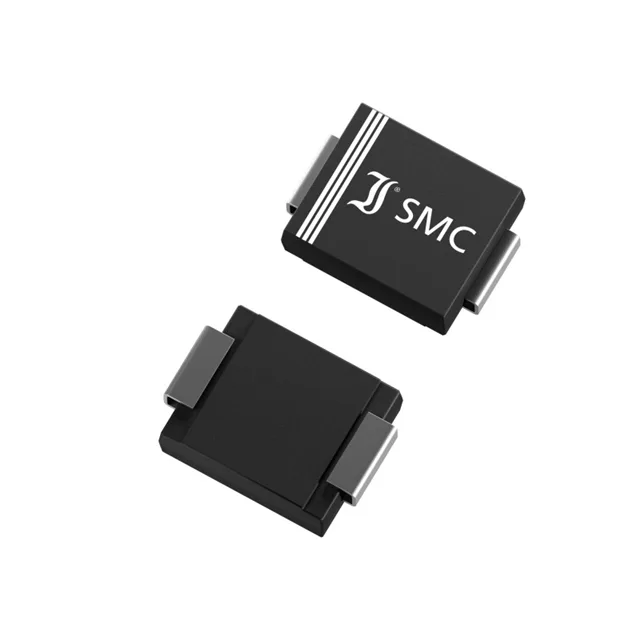
The SMC (DO-214AB) package is the standard TVS footprint for this power class — the cathodic tab is the thermal conductor, and the land pattern under that pad sets the thermal resistance to the board copper. Junction temperature is rated to 150°C with a storage floor at -50°C, so the board-level heat sinking matters: if the transient energy is repeated, the tab must shed heat faster than the next event arrives. A single-shot surge at rated energy stays within the thermal capacity; a burst sequence derates the effective rating.