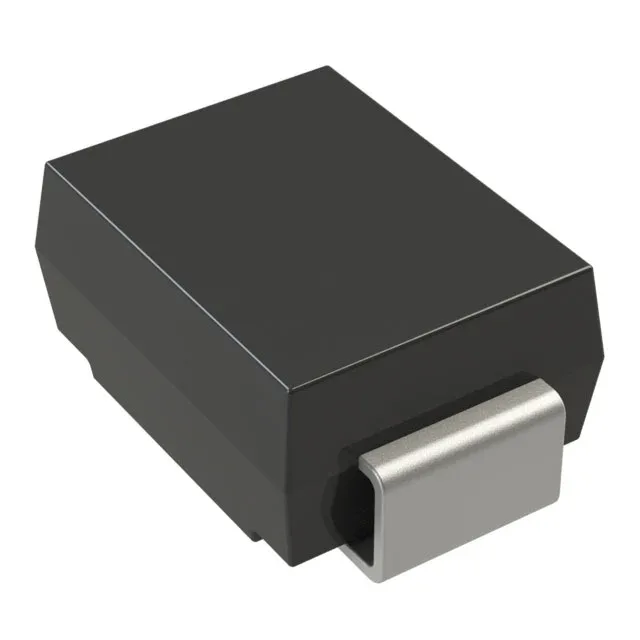
1.5 kW TVS in a DO-214AB footprint
The SMCJ78AQ-13-F: The 78 V reverse standoff voltage means it sits across a 78 V DC rail without conducting leakage; clamping occurs at 126 V maximum when the transient hits. The 11.4 A peak pulse current is the current the device shunts during that clamped event — the 1500 W rating is the product of clamp voltage and peak current at the test waveform. The junction operates from -55°C to 150°C, covering industrial and automotive ambient ranges with margin.
Clamping voltage and breakdown margin
The minimum breakdown voltage is 86.7 V, which sets the guard band above the 78 V standoff. A 48 V or 60 V rail protected by this device sees no conduction during normal operation; a transient that drives the rail above 86.7 V triggers avalanche breakdown and the diode clamps to 126 V. The 39.3 V difference between standoff and clamp is the voltage the downstream circuitry must survive — a DC-DC converter with a 100 V input rating has headroom. Power line protection is marked as No, confirming this is a signal- or low-power-rail TVS, not a primary AC mains protector. The unidirectional configuration biases the cathode to the protected rail and anode to ground; reverse-polarity events forward-bias the junction and conduct without clamping.