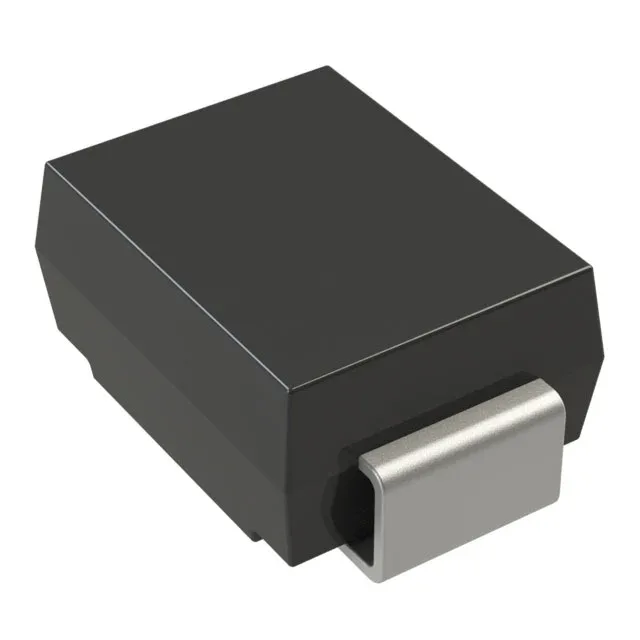
1.5 kW bidirectional Zener TVS for 64 V rails
The SMCJ64CAQ-13-F: Its 64 V reverse standoff voltage (VRWM) protects 48–64 V DC buses — common in automotive 48 V mild-hybrid systems, industrial 48 V PoE injectors, and 60 V telecom rectifier outputs — by clamping transients at 103 V maximum before the downstream regulator or load sees overstress. For a BOM targeting under-hood or chassis-mounted ECU modules, this certification is the gate to PPAP submission without a separate qualification run.
Clamp voltage and pulse current — what 103 V at 14.6 A means for your rail
This margin ensures that a 64 V nominal bus — which may already ride at 68 V under normal load transients — stays below the TVS clamp until a real surge event, avoiding nuisance clamping that would otherwise stress the TVS and waste power. The 1500 W peak pulse rating at 10/1000 µs is the standard telecom surge waveform. For shorter pulses (8/20 µs, common in ESD or lightning indirect strikes), the peak power capability is higher — the device can absorb several kilowatts for a few microseconds. The DO-214AB (SMC) package's copper leadframe and large solder pad on the cathode side keep the junction-to-ambient thermal resistance low enough to survive repetitive surges at the rated duty cycle.
Active production and sourcing posture
For a procurement manager qualifying this part into a new automotive BOM, the active status means the manufacturer continues to support design-ins and volume orders through authorized channels.