What the 1500 W peak pulse rating means for your protection design
The SMCJ14CAQ-13-F: At that condition the clamping voltage is held to 23.2 V max when the peak pulse current reaches 64.7 A. For a 14 V nominal rail, the 15.6 V minimum breakdown voltage means the device starts conducting before the protected circuitry sees overvoltage damage, and the 23.2 V clamp keeps the let-through voltage within the safe operating area of downstream 30 V-rated components. Because it is bidirectional, a single part protects both positive and negative transients on a single signal line — useful for AC-coupled data interfaces or power rails where reverse-polarity events are possible.
AEC-Q101 qualification — the automotive reliability baseline
The SMCJ14CAQ-13-F carries AEC-Q101 qualification, meaning it has passed the semiconductor device stress tests for automotive-grade reliability: temperature cycling, high-temperature reverse bias, and ESD robustness per the AEC-Q101 test matrix. The operating junction temperature range spans -55°C to +150°C, covering the under-hood and cabin thermal profiles where ambient can reach 85°C and the device self-heats under surge.
DO-214AB SMC package — board-fit and footprint compatibility
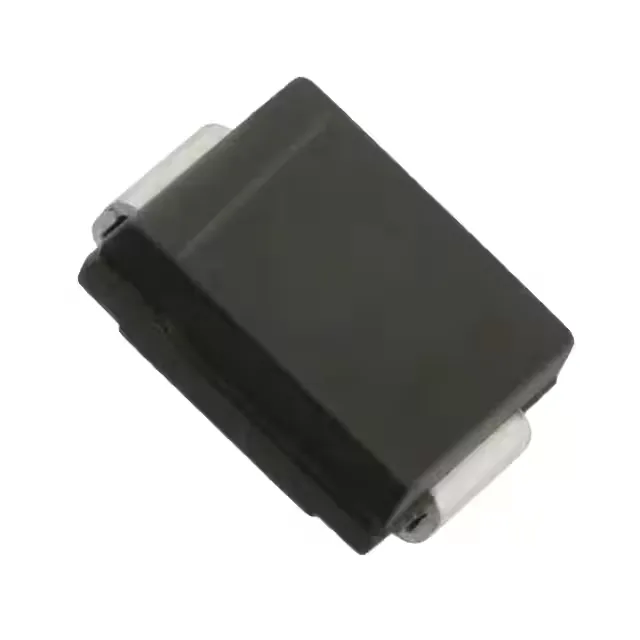
Housed in the DO-214AB (SMC) surface-mount package, the SMCJ14CAQ-13-F uses the standard JEDEC footprint for this body size — the same pad layout used by other 1500 W TVS diodes in the SMC package, so a PCB already designed for a competitor's SMC TVS accepts this part without a board spin. The tape-and-reel packaging suits automated pick-and-place assembly in medium-to-high volume production.