600W peak pulse, 64V standoff — the clamping profile for a 48V rail
The SMBJ64CA-13: Its 64 V reverse standoff voltage sits just above a nominal 48 V DC bus — the device stays transparent during normal operation and only starts conducting when the line exceeds the 71.1 V minimum breakdown threshold. That clamping ceiling is the number your downstream silicon sees during a surge — if the protected IC's absolute-max rating is below 103 V, this part alone won't hold the line; you need a lower-voltage TVS or a secondary clamp. The single bidirectional channel handles both positive and negative transients on the same pair of pins, which saves a diode count on bipolar rails or signal lines that swing below ground.
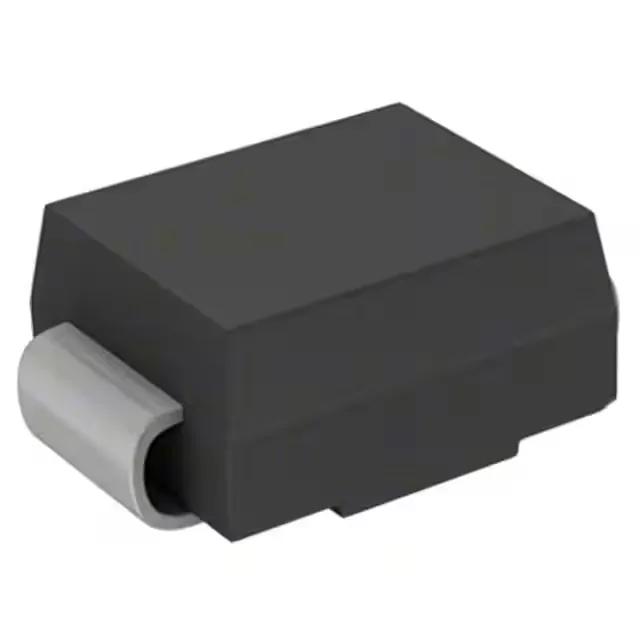
DO-214AA SMB footprint — what the package tells the layout
The supplier device package is also SMB, so the land pattern is consistent across the series — a single PCB footprint covers the whole voltage range from 5.0 V to 170 V. No derating is needed at 85°C ambient, but above 125°C the 600 W rating follows the standard exponential derating curve; the layout should keep the cathode tab pad on a decent copper pour to pull heat out of the junction. Power line protection is marked as 'No' — this is a signal- or low-power-rail TVS, not designed for the continuous energy of a mains-fed bus. Use it on data lines, I/O ports, or DC supplies under 64 V where the transient energy fits the 600 W pulse budget.
Active production — no last-time-buy pressure
Because it is a current-production part, the supply chain is stable and the BOM line does not carry obsolescence risk.