Three voltage thresholds define the guard band
The SMBJ64A-13: Reverse standoff voltage is 64V — the rail the TVS protects should not exceed this during normal operation. The gap between 64V and 71.1V is the guard band where the device transitions from off to conducting; a rail that sags below 64V under load is safe, but one that rides near 68V in steady state may see leakage increase. The 600W peak pulse rating is derated at elevated temperatures per the standard power-derating curve — at 150°C ambient the device can handle roughly 20% of the room-temperature rating, so a hot environment requires a higher peak-power part or a larger package.
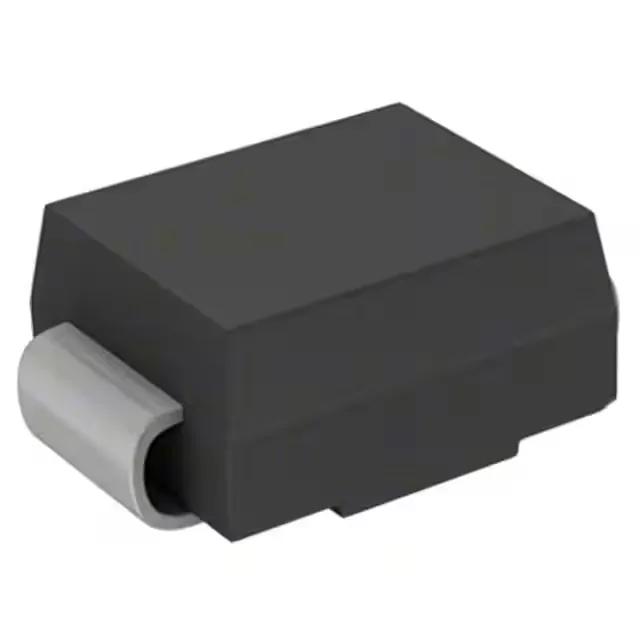
DO-214AA (SMB) footprint and surface-mount assembly
Housed in the DO-214AA (SMB) package, a standard JEDEC outline for medium-power TVS diodes. The SMB footprint is smaller than SMC but larger than SOD-123; typical pad layout uses a 2.0 mm x 2.0 mm cathode pad and a 1.5 mm x 2.0 mm anode pad with 0.5 mm clearance between them. Reflow profile follows standard lead-free solder (260°C peak). The part is unidirectional, meaning it has an anode and cathode — polarity matters. For AC or bidirectional protection you would need two devices back-to-back or a dedicated bidirectional TVS.