Clamping parameters and the protection window
The SMBJ43A-13: A 43 V reverse standoff means this TVS stays off the rail up to that DC bias — the circuit sees no leakage penalty in normal operation. Breakdown starts at 47.8 V min, so a 48 V transient is the first edge the diode starts shunting. Clamp voltage is 69.4 V at the rated 8.6 A peak pulse current — the load must survive that ceiling for the 10/1000 µs waveform. The 600 W peak pulse power is the energy-handling headline, but the clamp voltage at the actual surge current is what determines whether the downstream IC sees a destructive overvoltage. Derate the 600 W figure above 25 °C per the datasheet curve — at 85 °C ambient the derating factor is typically 0.7×, leaving 420 W effective.
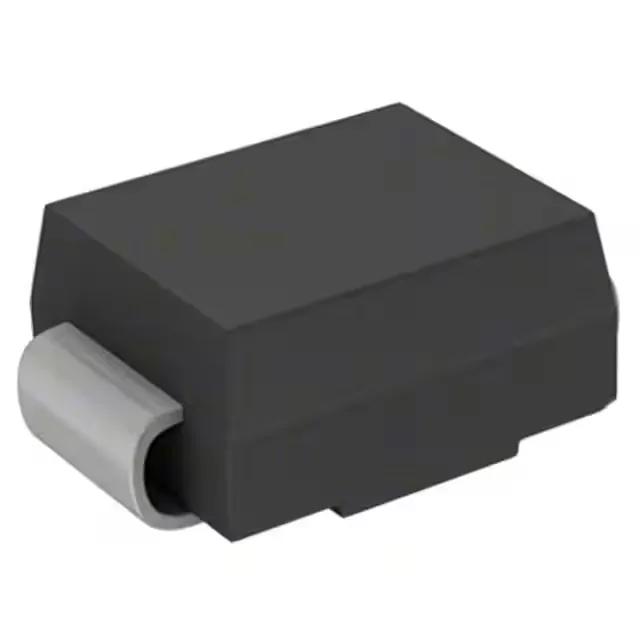
DO-214AA SMB is a standard surface-mount footprint shared across the SMBJ family. The cathode band marks the unidirectional orientation — the single channel is polarity-sensitive, so a 180° rotation puts the junction in forward conduction and the protection fails. Reflow profile follows JEDEC J-STD-020 for the MSL level on the reel label. Operating temperature range is -55 °C to 150 °C junction — this covers the full industrial ambient band and most under-hood automotive environments. No derating needed below 25 °C, but the peak pulse power drops linearly above that.
Sourcing posture and lifecycle
The SMBJ series includes multiple standoff voltages in the same DO-214AA footprint — a BOM change to a different voltage (e.g. SMBJ5.0A through SMBJ170A) is a drop-in board swap if the protection threshold changes.