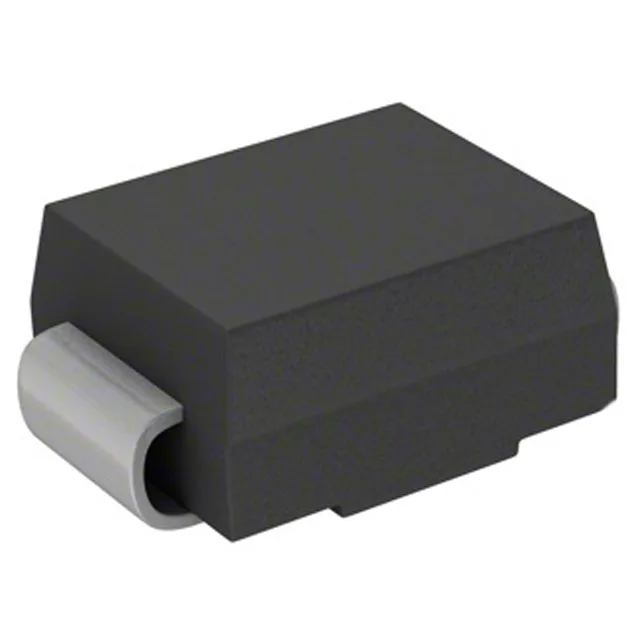
600 W peak pulse, 30 V rail — what the ratings mean on the board
The SMBJ30AQ-13-F: When a transient exceeds that, the device clamps at 48.4 V maximum while shunting 12.4 A peak pulse current, holding the downstream silicon inside its safe operating area. It is a single unidirectional channel (one TVS cell per package), so the cathode band on the DO-214AA SMB body marks the protected side — orientation matters. The junction temperature range spans -55 to 150 °C, covering the full automotive thermal envelope from cold-crank to under-hood soak.
AEC-Q101 automotive grade — the qualification that decides fit
This part carries AEC-Q101 qualification, the automotive discrete semiconductor stress test — it has passed the reliability screening (temperature cycling, HTRB, ESD, and moisture resistance) that consumer-grade TVS parts skip. Production status is Active — still in the Diodes Incorporated catalog, no NRND flag, no last-time-buy clock running. The base product number is SMBJ30, so the -13-F suffix denotes the tape-and-reel packaging variant; the die and the electrical specs are identical across the suffix options.
Field-swap reality — DO-214AA SMB and what it takes to replace
The DO-214AA (SMB) package is a standard surface-mount footprint — two-terminal, JEDEC-registered, with a cathode band that is readable under a headlamp. On a customer site, with a hot-air rework station and a pair of tweezers, you can swap this in under two minutes. No underfill, no thermal pad alignment, no orientation guesswork — the band points toward the protected rail.