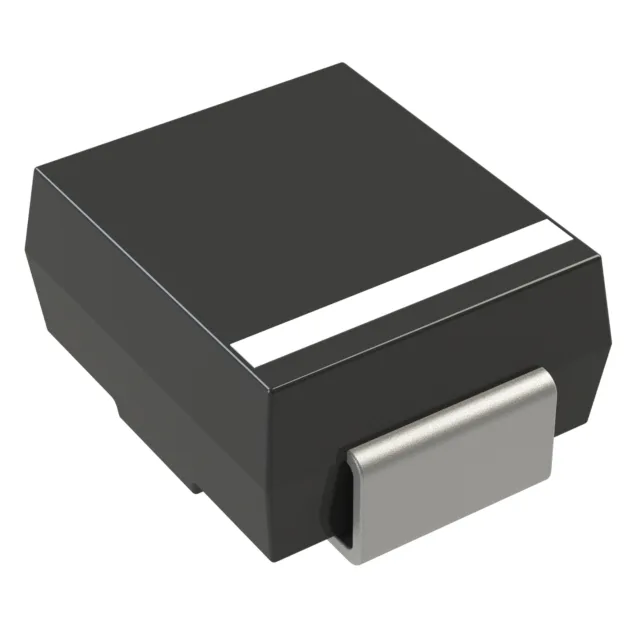
AEC-Q101 grade and what it means for your BOM
The SMBJ18AQ-13-F carries AEC-Q101 qualification — the automotive discrete semiconductor stress test. That means the part has passed the full suite: temperature cycling, moisture resistance, high-temperature reverse bias, and electrostatic discharge sensitivity per the AEC-Q101 rev E standard. For a Tier-1 or OEM auditor, this is the documentation they expect in a PPAP package. Junction temperature range spans −55°C to +150°C. This covers the under-hood ambient profile with margin — a 125°C engine-bay soak leaves 25°C of junction headroom before derating begins.
Transient protection envelope for an 18V rail
The 18V reverse standoff voltage (VRWM) means the part does not conduct at the normal 12V or 18V supply rail; it starts avalanching at 20V minimum breakdown. Peak pulse power is rated 600W for a 10/1000µs waveform. At that pulse condition the clamping voltage maxes at 29.2V while the peak current hits 20.5A — a 24V-rated downstream IC sees headroom before the clamp fires. The part does not include power line protection — it is designed for signal or low-power supply bus clamping, not AC mains or high-current DC bus. The unidirectional polarity suits a single-rail 12V or 18V automotive bus where the negative terminal is chassis ground.
Package, mounting, and board-fit
DO-214AA (SMB) surface-mount package — the standard JEDEC footprint for this power class. The copper pad area under the cathode tab sets the junction-to-ambient thermal resistance; a 600W pulse at 25°C ambient leaves the junction well within the 150°C limit for the pulse duration. Supplied on tape and reel — the '13-F' suffix denotes the 13-inch reel quantity. Cut tape is also available for prototype or low-volume builds.