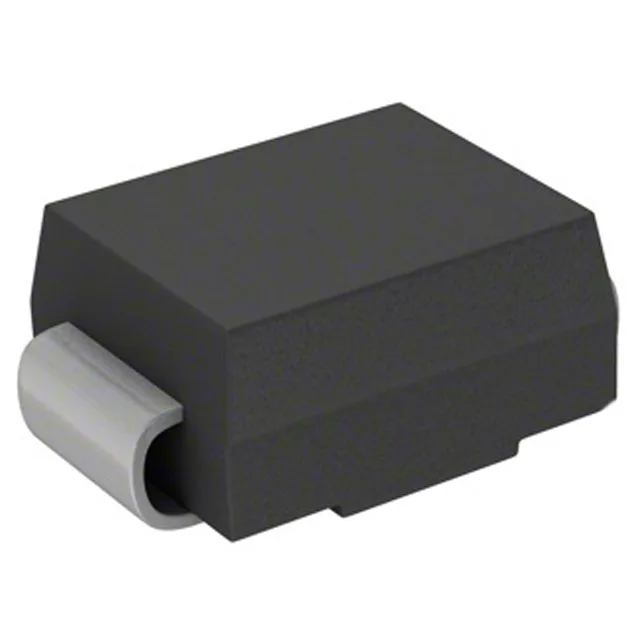
Automotive-grade transient suppression for 12V rails
The SMAJ7.5CAQ-13-F: Qualified to AEC-Q101, this part is screened for the -55°C to 150°C junction temperature range required under the hood. The bidirectional configuration — a single device clamps both polarities — simplifies board layout on AC-coupled or floating signal lines where the transient polarity is unknown.
Clamping voltage and breakdown margin
With a 7.5V reverse standoff voltage (working voltage), the diode remains transparent to the protected rail under normal conditions. The minimum breakdown voltage of 8.33V provides a guard band above the standoff, ensuring the device does not conduct leakage current during steady-state operation. The 400W peak pulse power rating is specified with a 10/1000µs waveform per industry standard. For shorter-duration transients (e.g. 8/20µs per IEC 61000-4-5), the device can absorb significantly higher peak power — a common derating practice in automotive ECU designs where the threat model includes fast ESD and EFT events.
DO-214AC SMA package and board integration
Housed in the standard DO-214AC (SMA) package, the SMAJ7.5CAQ-13-F mounts on the PCB with a surface-mount footprint shared across the SMAJ series. The SMA package body measures roughly 4.6 mm x 2.8 mm, fitting into tight layouts on engine-control or sensor modules where board space is at a premium. The junction operates from -55°C to 150°C, covering the full automotive temperature envelope. No power line protection is claimed — this is a pure transient suppressor, not a series element, so it sits in parallel with the protected load.
Active production and sourcing posture
The SMAJ series includes other voltage variants sharing the same package and footprint, but the 7.5V bidirectional automotive grade is a distinct BOM line.