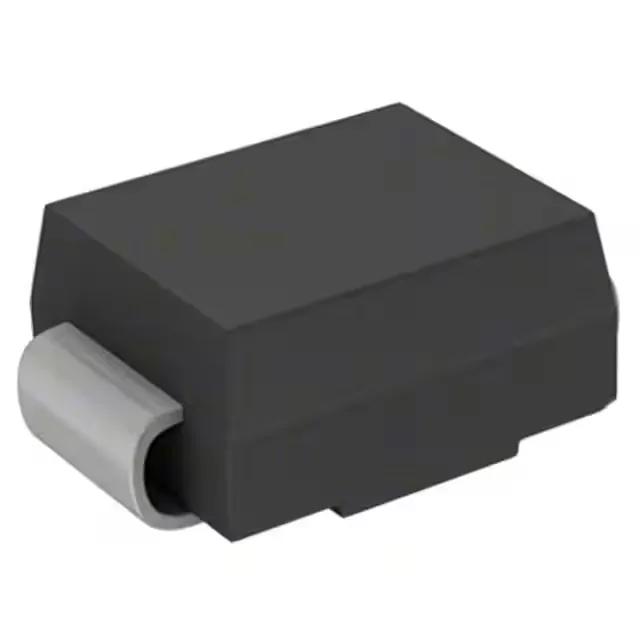
The SMAJ64CA-13 is a bidirectional TVS diode from Diodes Incorporated, rated for 400 W peak pulse power at the standard 10/1000 µs waveform. That 400 W rating defines the energy it can absorb in a single surge event — a 64 V rail hit with a 3.9 A transient gets clamped to 103 V max, keeping downstream silicon within its breakdown margin.
Standoff, breakdown, and clamp — the three voltages that define the protection window
Breakdown starts at 71.1 V min, and clamping maxes at 103 V at the rated 3.9 A peak pulse current. The gap between standoff and clamp is the protection window: a 64 V supply rail sees no leakage under normal operation, but a transient above 71.1 V triggers the avalanche and the voltage is held to 103 V. Bidirectional (one channel) means it clamps both polarities symmetrically — useful on AC signal lines or DC rails where reverse polarity is a risk.
DO-214AC SMA — board-fit and thermal reality
Surface-mount in the DO-214AC (SMA) package, supplier device package SMA. The copper pad area under the cathode tab sets the junction-to-ambient thermal resistance — for a 400 W pulse, the short duration means the die absorbs the energy, not the board, so pad size matters less for surge than for repetitive power dissipation. Tape & Reel packaging aligns with high-volume pick-and-place. Operating temperature range is -55°C to +150°C junction — wide enough for industrial enclosures and under-hood automotive ambient. The high-temperature end matters because leakage current in a TVS doubles with temperature; at 150°C the standby current is higher than the 25°C datasheet typical, but the 64 V standoff still holds without false triggering.
Product status is Active per Diodes Incorporated. For a protection diode that sees no wear in normal operation, the active status means the BOM line is stable for the production run — no last-time-buy scramble, no second-source qualification needed unless the buyer wants a hedge.