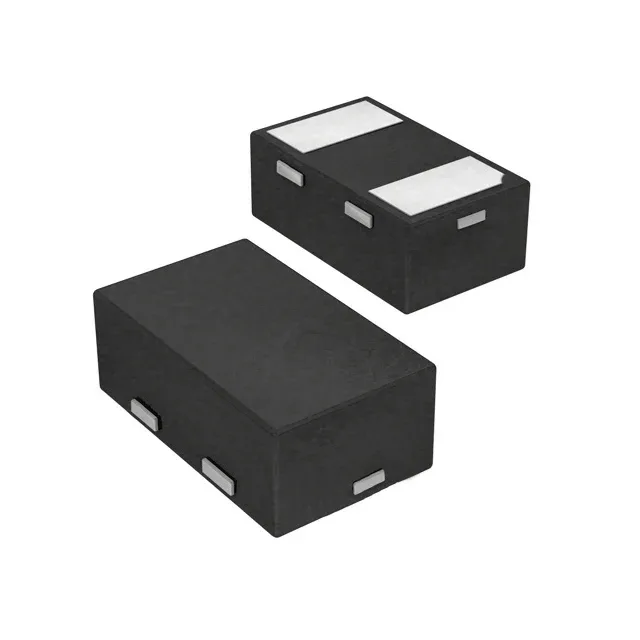
0.48 pF capacitance — the signal-integrity spec that decides fit
The D5V0X1BA2LPQ-7B: The 0.48 pF capacitance at 1 MHz is the headline parameter for high-speed signal lines. A TVS with capacitance above 1 pF loads the differential pair and degrades the eye diagram at multi-gigabit data rates; this diode stays under 0.5 pF, so it preserves signal integrity on HDMI 2.0 and USB 3.x lanes without adding a separate series termination. This gives a 9 V headroom between the rail and the clamp — enough to absorb a typical ESD strike without letting the transient through to the downstream IC.
AEC-Q101 — the qualification that opens automotive BOM slots
The operating temperature range spans -55°C to 150°C junction, covering the under-hood and cabin ambient requirements for a 12 V battery system.
0402 footprint — board-space trade-off
The X1-DFN1006-2 package is the 0402 metric footprint (1.0 mm × 0.6 mm) with two side-wettable terminations. It saves roughly 60% board area versus a standard SOD-523 package, which matters when placing a TVS on each differential pair of an HDMI or USB connector. The trade-off is that the small pad area limits the peak pulse power dissipation — the 4 A (8/20 µs) rating is the maximum the package can sink without exceeding the junction temperature.