Clamping voltage and standoff — what they mean for your signal line
The D5V0M1U2S9-7 is a single-channel Zener TVS diode rated for 5.5V reverse standoff — this is the maximum DC voltage the protected line can carry without the device conducting. When a surge exceeds 6.2V breakdown, the diode clamps the transient to 12V max at 9A peak pulse current, shunting the energy away from the downstream IC. The 108W peak pulse power rating tells you the device can absorb a single 8/20µs surge of that magnitude — enough for typical ESD and low-energy transient events on signal lines, but not for direct lightning or high-energy power faults.
Package and board-fit for space-constrained layouts
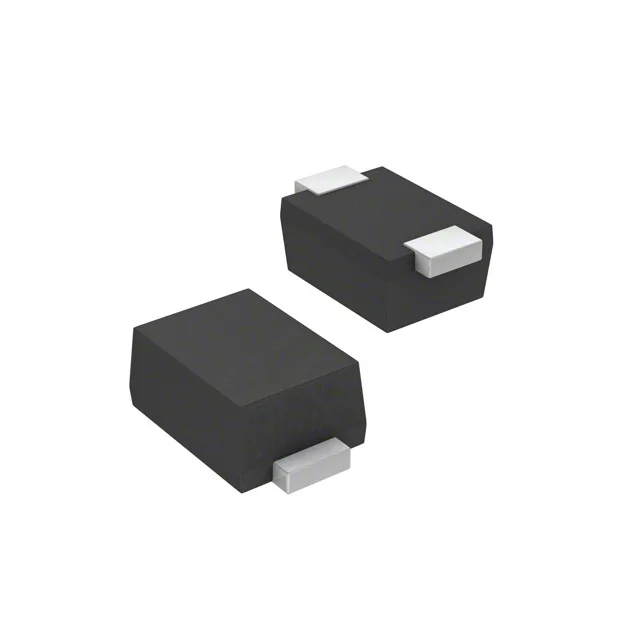
Housed in a SOD-923 package, this is one of the smallest TVS footprints available — 0.8 mm × 0.6 mm typical. The surface-mount profile suits dense PCB layouts where every square millimeter counts, such as mobile, wearable, or compact IoT modules. The 54pF capacitance at 1MHz is low enough for most general-purpose signal lines up to a few MHz, but for high-speed interfaces like USB 2.0 or gigabit Ethernet you would want a sub-5pF part. No power line protection means this is strictly for signal-line clamping — do not use it on supply rails.
Temperature range and production status
Operating from -65°C to 150°C, the device covers military and industrial temperature extremes — suitable for outdoor, automotive cabin, or engine-adjacent environments where the ambient sees wide swings.