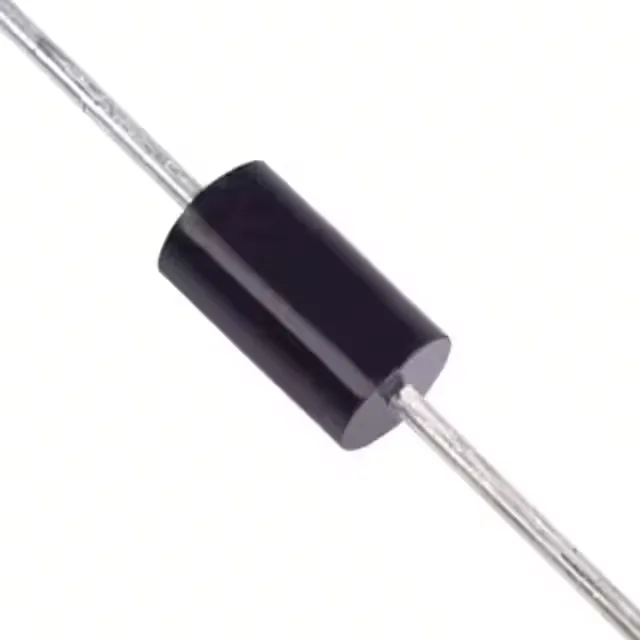
1500 W peak pulse — the rating that defines the protection envelope
The 1.5KE75A-T: That 1.5 kW rating sets the transient energy it can absorb without failing — for a given rail voltage, the clamping voltage and pulse width determine whether this part survives a surge or the energy exceeds the device's SOA. With a reverse standoff of 64.1 V and a minimum breakdown of 71.3 V, it sits on a 48 V or 60 V DC bus and starts conducting only when the transient pushes above the breakdown threshold. The clamping voltage at 14.6 A peak pulse is 103 V — the maximum voltage the downstream circuitry sees during the event.
Obsolete — sourcing reality for a discontinued TVS
Diodes Incorporated lists the 1.5KE75A-T as Obsolete. For a BOM line that still calls out this order code, the supply path runs through independent surplus and excess inventory channels — not through franchised distribution. The DO-201AA axial package is a legacy through-hole footprint still common in industrial and telecom boards. If a board spin is an option, a surface-mount TVS in the same voltage class (e.g.
Temperature range and package — board-fit considerations
The axial leaded DO-201 package requires through-hole soldering; the lead bend and body clearance above the board must accommodate the reflow or wave-solder profile without thermal stress on the glass passivation. Power line protection is marked as 'No' — this is a unidirectional TVS intended for DC rails, not for AC mains or bidirectional clamping. The single channel protects one rail; for a dual-polarity or AC line, a bidirectional TVS or two back-to-back devices would be needed.