What the 1500W rating means for your protection design
The 1.5KE51A-B is a 1500W (1.5kW) peak pulse power Zener TVS diode from Diodes Incorporated, designed to clamp transient overvoltages on signal or DC power rails up to 43.6V nominal. The 1500W rating is tested with a 10/1000µs exponential waveform — the standard surge shape for telecom and industrial transient immunity per IEC 61000-4-5. For a shorter pulse, say 8/20µs, the peak power capability is higher; for longer events, derate accordingly. The protection window is defined by three voltages: reverse standoff (43.6V typ), breakdown (48.5V min), and clamping (70.1V max at 21.4A peak pulse current). A 48V rail sits above the standoff voltage, so this part would conduct leakage current continuously — it is sized for 36V or 42V rails where the steady-state line stays below 43.6V. The 21.4A peak pulse current at the clamping voltage gives the surge capacity margin for a typical telecom secondary-side protector.
Obsolete — sourcing through independent channels
Diodes Incorporated lists the 1.5KE51A-B as Obsolete. No pin-compatible direct replacement from Diodes Inc is documented; if your BOM calls for this exact axial-lead DO-201 footprint, the existing board layout is the constraint. Each lot is verified for RoHS compliance and traceability before shipment.
DO-201 axial package and board integration
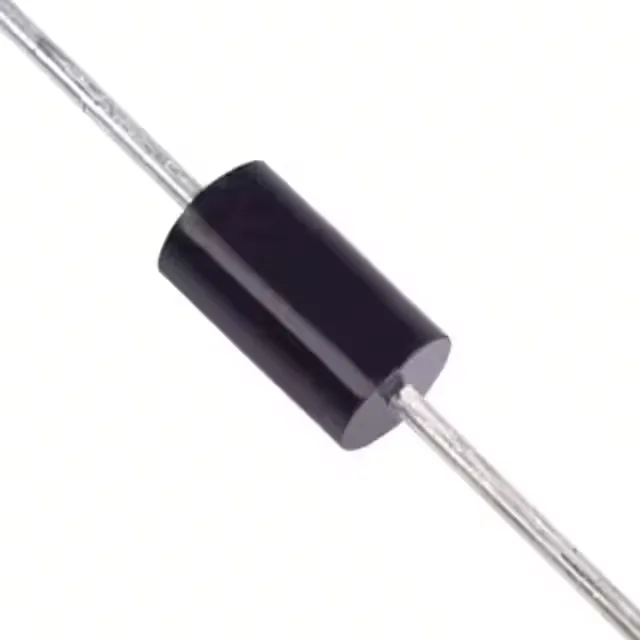
The 1.5KE51A-B comes in a DO-201AA / DO-27 axial-lead through-hole package, with the supplier device package designated DO-201. The axial leads are tin-plated copper, intended for wave-solder or hand-solder assembly. The body is molded epoxy with a color-band cathode marking. Lead spacing is standard for 0.100-inch pitch through-hole layouts — the leads are trimmed and formed to fit a 0.35-inch (8.9mm) hole spacing typical of axial-lead diode footprints. The wide junction temperature rating means the TVS can be placed in high-ambient locations (e.g., near a power supply or engine-bay ECU) without derating the pulse power capability at elevated temperatures — though the clamping voltage shifts slightly with temperature per the Zener coefficient.
Unidirectional — polarity matters on the board
This is a unidirectional TVS, meaning it clamps one polarity (reverse-bias) and conducts like a forward-biased diode on the other. For a positive-voltage rail referenced to ground, the cathode goes to the rail and the anode to ground — the part protects against positive overvoltage transients. For a negative rail or AC-coupled signal line, a bidirectional TVS (two Zener junctions back-to-back) would be needed. The unidirectional type has a lower clamping voltage for a given standoff than a bidirectional equivalent, because only one junction is in the clamp path.