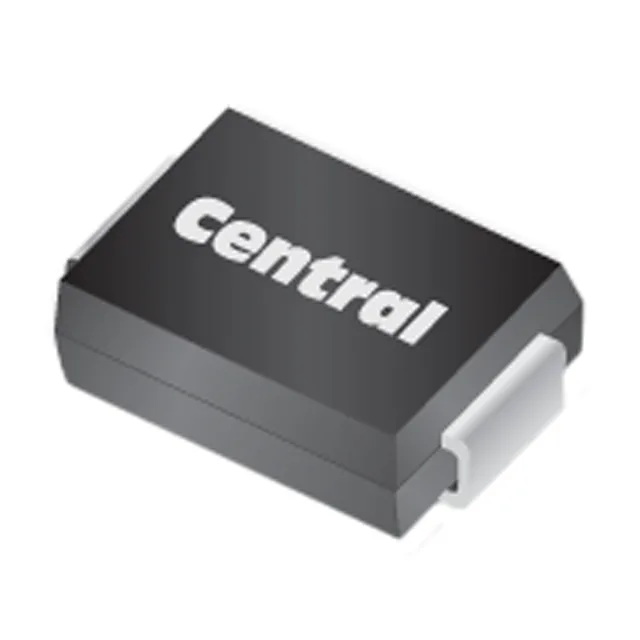
1.5SMC9.1A — what the protection ratings mean
The 1.5SMC9.1A TR13 PBFREE: It does not absorb continuous power; it fires once per event and resets. The 7.78 V reverse standoff is the working voltage — the TVS stays off and invisible to the circuit until the bus exceeds that level, at which point it avalanche-clampers at 8.65 V breakdown minimum and limits the peak at 13.4 V. 112 A peak pulse current at 10/1000 µs means it clears the class of surge that kills downstream ICs on a 24 V industrial rail — IEC 61000-4-5 waveforms in that range. It is not rated as power-line protection (the spec table flags that explicitly), so do not deploy it as a primary MOV or gas-tube substitute on mains-adjacent inputs; it is a board-level transient suppressor on a signal or low-power rail that sees single-event surge. If the board runs in a confined enclosure that already loads the thermal budget, the TVS die temperature climbs with the board — keep the board-level ambient well below 125°C if you want margin against the 150°C limit, especially under repeated surge events where the clamping dissipation adds pulsed heat.
SMC package and board integration
DO-214AB (SMC) is the mid-size TVS package — larger than the SOD-123 used on lower-power suppressors and smaller than the P600 stud-body units. The cathode band on the sleeve marks the polarity bar; the Anode is the plain side. The wide thermal pad on the underside carries the surge dissipation — solder wetting on all three terminals and a thermally adequate land pattern under the body matters more than the body itself for transient survival. Tape-and-reel packaging at the TR13 reel code means standard SMT assembly flow: dry bake before reflow if the Moisture Sensitivity Level (MSL) applies (check the Central Semiconductor datasheet for the MSL rating, not in this spec table). No special profile is required for the SMC body; a standard SnPb or SAC paste ramp handles it.
Active production — what sourcing looks like today
Central Semiconductor Corp marks this as Active — no last-time-buy window, no documented end-of-life. The part ships in tape-and-reel on standard lead times through authorised distribution. No official second source or cross-reference successor appears in the record, so for a new design confirm the distributor lead time before committing the BOM position — the 7.78 V standoff puts it in a dense part-number column where several manufacturers offer similar 1.5 kW SMC TVS types, but the exact 9.1 V Zener voltage and PBFREE finish pin the selection to this code.