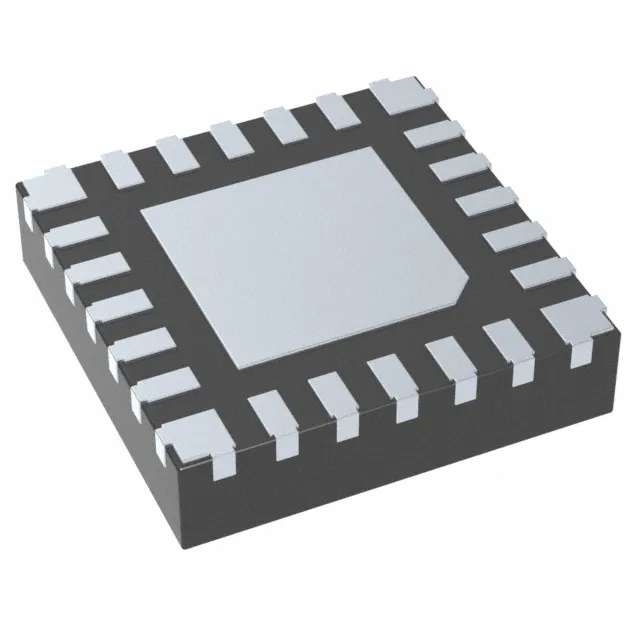
Core and memory budget for the embedded workload
The MAX32660GTG+ is an Analog Devices DARWIN-series ARM Cortex-M4F microcontroller clocked at 96 MHz, with a 32-bit single-core architecture that includes a hardware FPU and DSP extensions. This puts its throughput well above the Cortex-M0+ class—enough to run a real-time control loop alongside a communications stack without stalling on multiply-accumulate operations. On-chip memory totals 256 KB of Flash and 96K x 8 of SRAM. For a typical sensor-fusion or motor-control application, the Flash holds the firmware image and the SRAM provides headroom for buffering and stack—the 96 KB RAM is generous for a 24-pin package MCU.
Peripheral set and I/O flexibility
The part integrates I²C, SPI, and UART/USART connectivity, plus I²S for audio or serial-data streaming. On the control side, it carries PWM, DMA, and a watchdog timer, along with brown-out detect and power-on reset—enough peripheral mix to handle a sensor hub, a small HMI controller, or a motor-drive interface without external glue logic. With 14 general-purpose I/O lines in a 24-TQFN package, the pin count forces trade-offs: every peripheral mux reduces available GPIO, so the peripheral allocation needs to be locked early in the design phase.
The 0.5 mm pitch QFN footprint is manageable on a 2-layer board if the ground plane under the pad is stitched with vias; a 4-layer stack-up gives better thermal spreading.