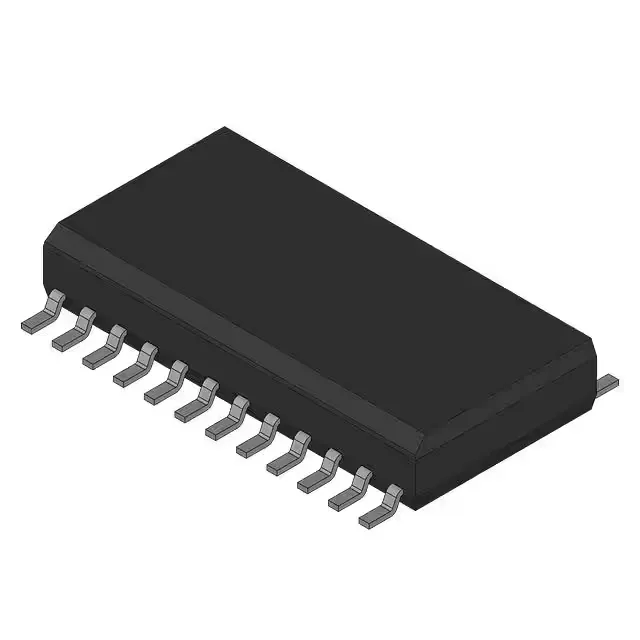
AMD (Xilinx) SN74LS646SG — Analog & Data Acquisition

SN74LS646SG Registered Bus Transceiver, 3-State, 24-SOIC

MPNSN74LS646SG
End of Life

Texas Instruments SN74LS646SG, Registered Bus Transceiver, Non-Inverting, 3-State Output, 8-bit, 1 Element, Surface Mount, 24-SOIC (0.295", 7.50mm Width), Bulk.

$5.44Ref. price · indicative, final on quote
Packaging24-SOIC (0.295", 7.50mm Width)
StockContact for availability
MOQ1 pcs
  • 100% new & originalTraceable channels only — no refurbs, no pulls, no remarked parts.
  • Date & lot codes on quoteStated per line before you commit; label photos on request.
  • MSL-compliant ESD packingMoisture-sealed bags with indicator cards; reels photo-verified.
  • PayPal buyer protectionPay by T/T, PayPal or Payoneer — card payments covered end to end.

Specifications

SN74LS646SG Technical Specifications
ParameterValue
Logic typeTransceiver, Non-Inverting
Output type3-State
Mounting typeSurface Mount
PackageBulk
Case24-SOIC (0.295\", 7.50mm Width)
Number of elements1
Number of bits per element8

Product details

What this part is and where it fits

The Texas Instruments SN74LS646SG is an 8-bit registered bus transceiver with non-inverting 3-state outputs, packaged in a 24-SOIC wide-body surface-mount package. It is designed for bidirectional asynchronous communication between two data buses, with internal registers that latch data on either the A or B port under control of the clock and enable pins. Typical applications include memory-mapped I/O interfaces, microprocessor bus buffering, and backplane data transfer in industrial control or telecom equipment where registered data flow and bus isolation are required.

Registered transceiver — what the logic type means for the bus

The registered architecture means data on the A or B port is clocked into an internal flip-flop before being driven to the opposite port. This eliminates the need for external latches in applications where data must be held stable across bus-turnaround cycles, such as in multiplexed address/data buses or when interfacing a slower peripheral to a faster processor bus. The non-inverting path preserves data polarity, so a logic high on the input appears as a logic high on the output — no inversion to account for in the firmware or logic design.

3-state outputs and bus sharing

The 3-state output allows the transceiver to present a high-impedance state on the bus when the output enable is deasserted. This is essential for shared-bus topologies where multiple devices drive the same lines — only one transceiver drives the bus at a time, preventing contention and signal degradation. In a typical backplane or memory-mapped I/O system, the SN74LS646SG sits between the processor local bus and a peripheral bus, with the output enable controlled by the address decoder.

Package and mounting — board-fit check

The 24-SOIC wide-body package (0.295" body width, 7.50 mm) is a standard surface-mount footprint. The supplier device package is listed as 24-SOIC. Mounting type is surface mount. Bulk packaging means parts are shipped in tubes or trays, not tape-and-reel.

Frequently asked questions

Is SN74LS646SG RoHS compliant?

No, the SN74LS646SG is listed as RoHS non-compliant — it contains lead in the solder finish or other restricted materials. If your assembly process requires lead-free components, you will need to evaluate a different suffix variant within the 74LS646 family.

What is the difference between SN74LS646SG and SN74LS646?

The SN74LS646SG is the surface-mount 24-SOIC wide-body variant of the 74LS646 registered bus transceiver. The base part number SN74LS646 without a suffix typically refers to the DIP (through-hole) package. The logic function, pinout, and electrical characteristics are the same; only the package and mounting method differ.

What is the pinout of SN74LS646SG?

The pinout follows the standard 74LS646 registered transceiver layout for a 24-pin SOIC package. The A port occupies pins 2–9, the B port pins 11–18, with control pins (clock, output enable, direction) on pins 1, 10, 19, 20, 23, 24. Power (VCC) is pin 24, ground (GND) is pin 12. For a complete pinout diagram, refer to the SN74LS646 datasheet.