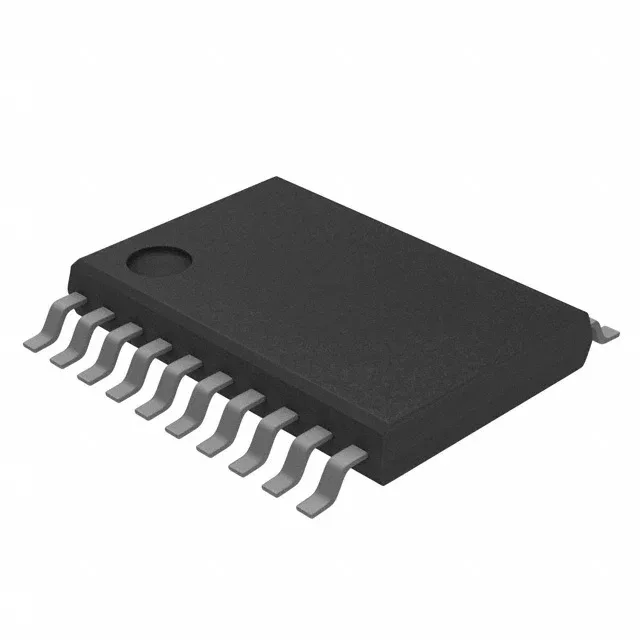
Texas Instruments TXS0108EPWR — Interface & Transceivers

TXS0108EPWR 8-bit bidirectional voltage-level translator

MPNTXS0108EPWR
Active

Texas Instruments TXS0108EPWR, 8-bit bidirectional voltage-level translator, 60 Mbps data rate, auto-direction sensing, open-drain and push-pull output, 1.4 V – 3.6 V VCCA / 1.65 V – 5.5 V VCCB, -40°C to 85°C, 20-TSSOP package.

$0.53495Ref. price · indicative, final on quote
Independent supplier — new & surplus stockAuthenticity-screened · ESD-safe packingListing updated Aug 2026

Specifications

TXS0108EPWR specifications
ParameterValue
Output typeOpen Drain, Push-Pull
Channel typeBidirectional
MountingSurface Mount
Translator typeVoltage Level
Voltage - VCCA1.4 V ~ 3.6 V
Voltage - VCCB1.65 V ~ 5.5 V
Operating temperature-40°C~85°C(TA)
PackageTape & Reel (TR); Cut Tape (CT)
FeaturesAuto-Direction Sensing
Data rate60Mbps
Case20-TSSOP (0.173\", 4.40mm Width)
Number of circuits1
Channels per circuit8

Product details

Eight channels, no direction pin — what auto-direction sensing buys you

The Texas Instruments TXS0108EPWR is an 8-channel bidirectional voltage-level translator that eliminates the direction-control pin by sensing the data flow on each channel automatically. That means one fewer GPIO on the microcontroller and no firmware toggling a DIR line during bus turnarounds — useful when you are translating a mix of I²C, SPI chip selects, and GPIO between a 1.8 V or 3.3 V host and a 5 V peripheral. The part handles both open-drain and push-pull outputs, so it covers multi-master buses and single-ended signalling in the same package.

60 Mbps — fast enough for most serial, not for parallel memory

The 60 Mbps data rate translates to roughly 60 MHz clock-equivalent on a single edge, which comfortably handles SPI at 50 MHz, UART at several Mbps, and general-purpose GPIO toggling. It will not work for DDR memory interfaces or high-speed parallel busses, but for the common case of bridging an MCU to a sensor, display, or legacy ASIC, the margin is generous. The auto-direction architecture introduces a propagation delay around 4–6 ns typical; budget that into your setup-and-hold timing if you are running near the rate limit.

The 5.5 V ceiling on VCCB is the hard limit — a 5 V rail that regulation holds at 5.0 V ±5% is fine; an unregulated 5 V supply that can hit 5.6 V at light load is not. The part is bidirectional, so data flows both ways simultaneously on different channels without a direction pin.

Housed in a 20-TSSOP (4.40 mm body width), surface-mount. The supplier device package is 20-TSSOP.

Frequently asked questions

What is the difference between TXS0108EPWR and TXB0108PWR?

Both are 8-bit bidirectional voltage-level translators from TI in the same 20-TSSOP package. The TXB0108PWR uses a different output-driver architecture that provides higher drive strength at the cost of slightly higher quiescent current. The TXS0108EPWR is optimized for lower power and auto-direction sensing with open-drain compatibility, making it a better fit for I²C and other multi-master busses. Pin-compatible between the two, so a board can be stuffed with either if the drive requirements are met.

Can TXS0108EPWR be used for 3.3V to 5V level shifting?

Yes. The auto-direction sensing handles bidirectional traffic at 60 Mbps, suitable for SPI, UART, and GPIO between a 3.3 V host and 5 V peripherals.

Is TXS0108EPWR bidirectional?

Yes, all eight channels are bidirectional with auto-direction sensing — no direction-control pin needed.