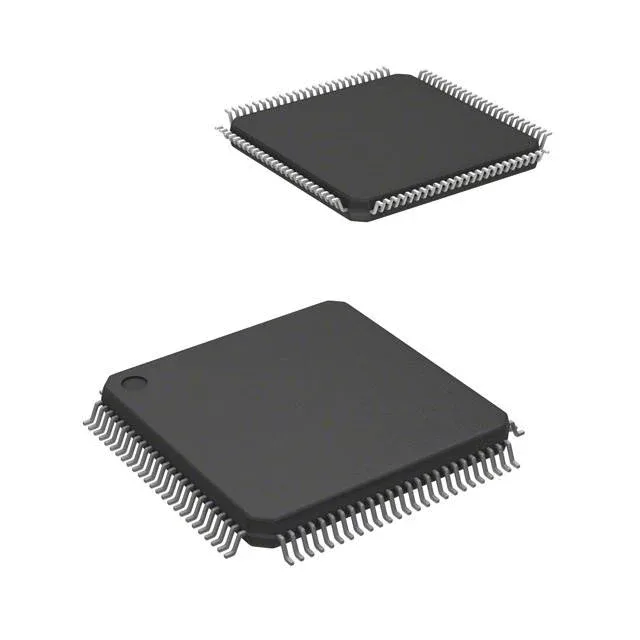
The TM4C1231D5PZIR runs a single ARM Cortex-M4F core at 80 MHz with a hardware floating-point unit. Memory partition is 64 KB Flash for code, 24 KB SRAM for variables and buffers, plus 2 KB EEPROM that survives power loss without an external serial chip. The EEPROM saves a board layer if you need to retain calibration constants or fault logs across resets.
Connectivity and I/O — CANbus as the backbone
The part carries CANbus, SPI, I²C, UART, SSI, and Microwire — the usual mix for industrial and automotive subnets. The CAN 2.0B controller is the standout: it lets the MCU sit on a multi-drop sensor/actuator bus without an external transceiver (just a CAN PHY).
100-pin LQFP, 14×14 mm body. Standard footprint for a mid-density MCU — no BGA routing complexity. The Tape & Reel delivery suits automated pick-and-place.