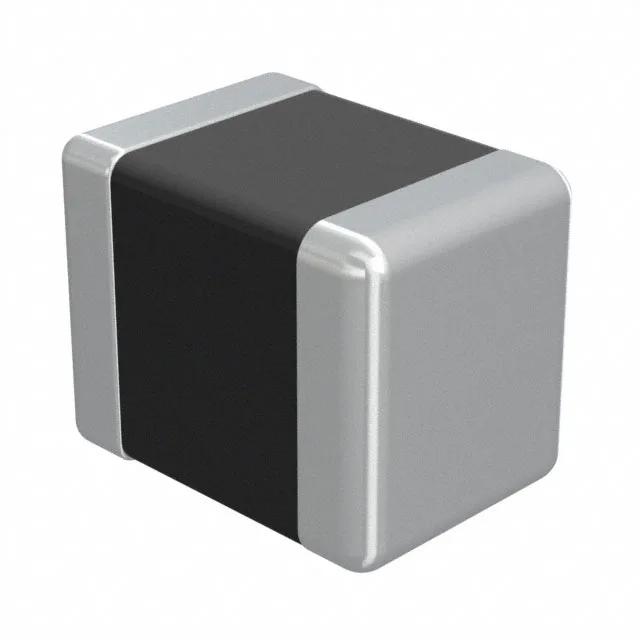
NRND — plan the last-time-buy window
Taiyo Yuden has marked the LBC2518T2R2MV as Not Recommended for New Design (NRND). This means it is still available for existing BOM lines, but the manufacturer will not support new designs with this part — a last-time-buy window is the prudent move for sustaining production. For a storeroom keeper, this is the signal to evaluate stock coverage: if your line consumes 630 mA per inductor and the 2.2 µH value is locked into the layout, securing a final quantity now avoids a forced board spin later.
2.2 µH, 630 mA — what the ratings mean for the power rail
The 2.2 µH inductance at ±20% tolerance is tested at 7.96 MHz — the standard test frequency for this value range. The 630 mA current rating is the DC bias current at which the inductance typically drops by 10% (self-heating limit); above that, the core saturates and the inductor behaves more like a short. DC resistance is 130 mOhm, which at 630 mA produces about 52 mW of I²R loss — negligible for most automotive modules but worth checking if the inductor sits in a tight thermal budget near a 105°C ambient ceiling. Self-resonant frequency is 68 MHz; above that the inductor becomes capacitive. For a buck converter switching at 2–4 MHz, this is well clear — but if you are filtering a high-speed digital line, the parasitic capacitance above 68 MHz will bypass the inductor.
AEC-Q200 — automotive-grade reliability
Rated AEC-Q200, the LBC2518T2R2MV has passed the stress tests for automotive passive components: thermal shock, moisture resistance, mechanical shock, and vibration. The unshielded construction means magnetic flux radiates from the core — adjacent traces carrying sensitive analog signals or high-impedance nodes need keep-out distance or a ground plane between them to avoid coupling.
1007 (2518 Metric) — board-fit and replacement
This footprint is common across many wirewound inductor families, so a pin-compatible alternative from another series (same inductance, current, and DCR) can be substituted without a board change — but confirm the unshielded vs shielded trade-off first. Supplied in tape-and-reel packaging (Cut Tape also available), the reel quantity is standard for 1007-size parts — store the reels in a dry environment; the part is not moisture-sensitive per AEC-Q200, but the reel label carries the bake requirements if exposed.