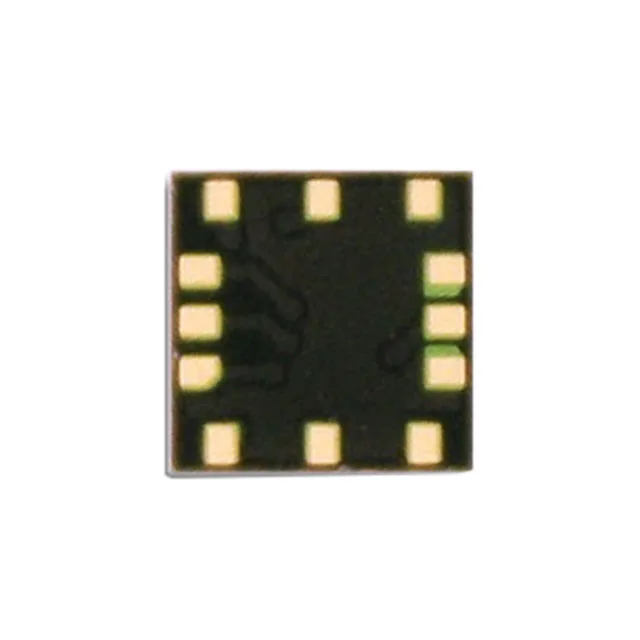
The ZMOD4510AI1V: This is a current-production part suitable for both new designs and existing BOM positions without a migration timeline.
I²C digital output and the 1.7 V supply rail
The sensor communicates over I²C, so the host MCU reads the OAQ measurement directly without an external ADC — the digital output eliminates analog routing and reference voltage errors in the signal chain. Supply voltage is 1.7 V, which lets the sensor run from a single Li-ion cell near end-of-discharge or from a standard 1.8 V logic rail. The 11 mA switching current keeps the power budget low enough for battery-operated environmental monitors that sample periodically.
Accuracy and temperature range for environmental sensing
The ±15% accuracy figure is the total error budget for the OAQ measurement — this includes sensor-to-sensor variation, drift over time, and the combined effect of temperature and humidity on the gas-sensing element. For outdoor air quality monitoring where the target is trend detection rather than lab-grade precision, this error band is acceptable; for a compliance-grade measurement, budget additional calibration or a reference sensor. Operating range spans -40°C to 65°C, covering outdoor enclosures in temperate and cold climates as well as unconditioned indoor spaces. The upper limit of 65°C means the sensor should not be placed near a heat source or inside a sealed enclosure that sees direct sun without ventilation.
Package and integration note
Supplied in a tray — the package is a surface-mount LGA-style footprint. The I²C bus requires pull-up resistors on SDA and SCL; the 1.7 V supply rail must be clean within the sensor's operating range. No external ADC or level translator is needed if the host MCU runs at 1.8 V logic.