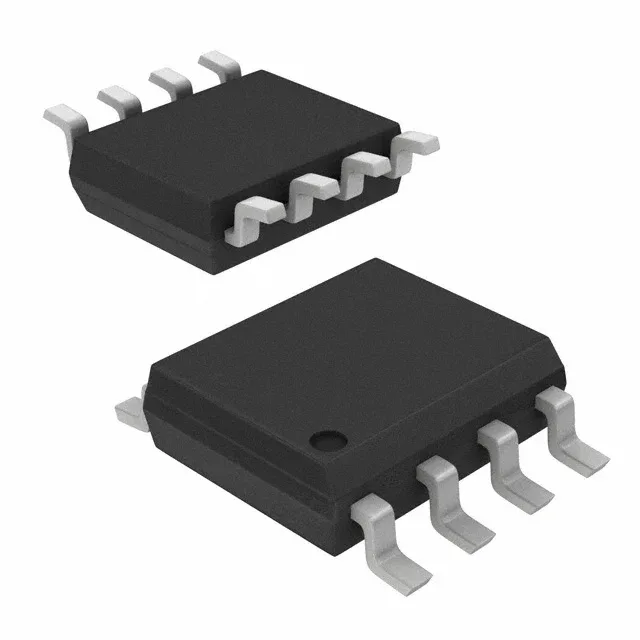
Active — still on the BOM for new builds
The X9314WSIZ: ROHS3 compliant — no lead, cadmium, or restricted phthalates in the package. The part ships in a tube, not tape-and-reel, so factor that into the pick-and-place feeder setup.
Logarithmic taper — for audio gain and logarithmic-scale adjustments
This is a logarithmic-taper digital pot, not a linear one. The resistance change per tap follows a log curve, which matches how human hearing perceives loudness — so it is the right choice for volume control, audio gain staging, or any application where the control variable is logarithmic. With 32 taps, the step size is coarse — about 312 Ω per tap at the low end and much wider at the high end. For fine trimming of a DC bias or a precision reference, a 128- or 256-tap pot is a better fit; this part is designed for applications where the coarse log steps are acceptable. The wiper position is stored in non-volatile memory — power cycle the board and the wiper returns to the last programmed setting without a re-initialization sequence. That matters for a volume knob that must survive a power glitch without resetting to zero.
5V rail, industrial temp, 8-SOIC — the board-fit constraints
The footprint is standard SOIC-8, so no special land pattern is required. The 40Ω typical wiper resistance adds a small series resistance in the signal path; at 10kΩ end-to-end, the voltage divider ratio is unaffected, but the wiper resistance does add a DC offset if the wiper current is non-zero. The total resistance tolerance is ±20%, and the temperature coefficient is ±600 ppm/°C. That means the absolute resistance can vary significantly from part to part and drifts with temperature — but for a logarithmic volume control, the ratio accuracy between taps is the important spec, not the absolute end-to-end value.
Renesas provides ROHS3 compliance documentation for this part.