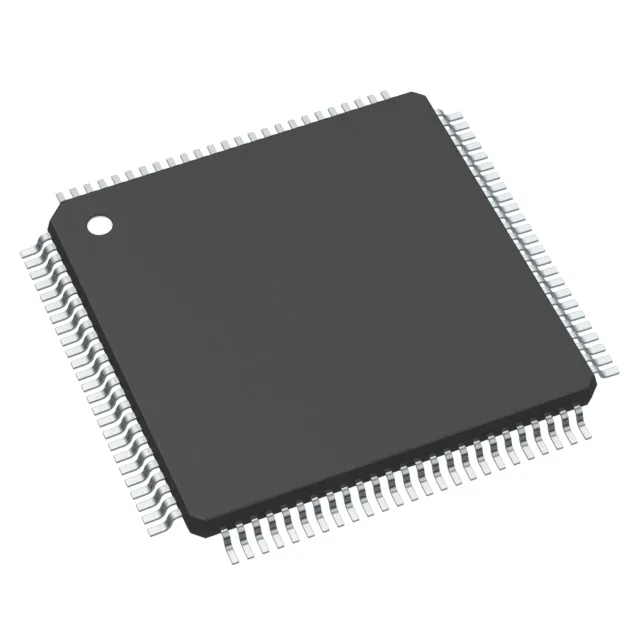
240 MHz Cortex-M33 for motor-control and industrial loops
The Renesas R7FA6T2AB3CFP#AA0 is a 32-bit ARM Cortex-M33 MCU from the RA6T2 series, clocked at 240 MHz. It targets real-time control applications where loop closure and deterministic response matter — motor drives, servo controllers, and multi-axis motion systems. The Cortex-M33 core brings TrustZone security separation, which is useful when you need to isolate a safety monitor task from the main control loop without a second chip. On the analog side, the part integrates 38 channels of 12-bit SAR ADC and 4 channels of 12-bit DAC. That ADC count covers three-phase current sensing plus a spare for DC-link voltage or temperature feedback without external muxing. The DAC outputs can generate analog reference or offset trim signals directly. Memory is sized for a single control algorithm: 256 KB Flash for the application code and motor libraries, 64 KB RAM for data and buffer frames, and 16 KB EEPROM for calibration constants and fault logs that survive power cycles.
Supply and temperature — what the -40 to 105°C range means
Peripherals and connectivity for a control node
The RA6T2 peripheral set includes DMA, LVD, POR, PWM, and WDT — the usual complement for a motor-control MCU. The PWM timers are the key block: they can generate center-aligned or edge-aligned waveforms with dead-time insertion for three-phase inverter bridges. DMA offloads ADC result transfers to RAM without CPU intervention, which keeps the control loop jitter low. Connectivity covers I²C, LINbus, SCI, SPI, and UART/USART. No CAN or Ethernet on-chip — those would need an external transceiver or a companion MCU. The SCI and SPI interfaces are sufficient for a local sensor bus (SPI to an absolute encoder) and a UART for Modbus RTU or debug console. LINbus is there if the board is part of an automotive body network.
ROHS3 compliance is confirmed, so it passes EU material declarations without an exemption hunt.