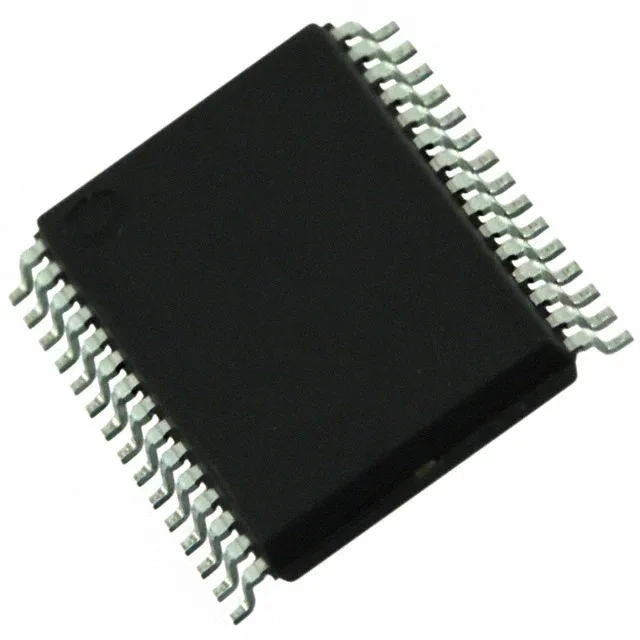
32 MHz RL78 core with 48 KB flash — what the memory split means for firmware
The R5F104ADASP#30 runs a 16-bit RL78 CPU at 32 MHz, with 48 KB of program flash and a separate 4 KB data EEPROM block — enough to hold a bootloader plus a control-loop application while keeping calibration constants or configuration tables in the EEPROM without wearing the flash. The 5.5 KB RAM is modest — fine for sensor fusion or motor-control state machines, but a data-logging application that buffers large ADC sequences will need external SRAM or careful buffer management.
Supply range and temperature grade — board-fit decisions
Industrial temperature grade (-40°C to 85°C) covers outdoor enclosures, HVAC ductwork, and factory-floor panels, but not under-hood automotive or engine-bay duty where 105°C or 125°C parts are required.
30-LSSOP package — hand-solderable for prototypes
With 21 I/O brought out in a 30-pin body, the pin density is low enough that a two-layer PCB can route most signals without via congestion.
Peripheral set — ADC, serial buses, and on-chip safety
An 8-channel 8/10-bit ADC reads analog sensors (thermistors, potentiometers, current shunts) at up to 10-bit resolution — adequate for most control loops, though not for precision measurement. Serial connectivity includes CSI (clocked serial interface), I²C, LINbus, and UART/USART — covers common sensor buses, LIN for automotive subnets, and legacy RS-232 links.
Active lifecycle and compliance — no design-in risk
New designs can proceed without a migration path contingency. ROHS3 compliant — meets the current EU restriction on hazardous substances; no exemption expiry to track.